Small Business Marketing Budget: How Much to Spend and Where
How much should a small business spend on marketing? Three ways to set the number, worked examples, how to split it by stage, what to cut first, and a template you can copy.
The right small business marketing budget is the amount that buys new customers at a cost your margins can carry, plus enough fixed spend to keep the machine running. Set it in this order: work out what a customer is worth to you, decide the most you can pay to win one, multiply by the number of customers you need, then check the total against what your cash flow can handle. A percentage of revenue is a useful sanity check, not the answer.
If you want a quick starting point, this guide gives you three ways to set the number (percent of revenue, goal based, and unit economics), worked examples you can copy, a split by business stage, a testing plan, a seasonal calendar, a tracking routine, an order for cutting when money is tight, and a budgeting template at the end. Every number in the examples is hypothetical and labelled that way. Swap in your own.
Why most small businesses get their marketing budget wrong
Most owners set their marketing budget one of three ways: whatever is left over at the end of the month, whatever a competitor seems to spend, or whatever the last agency proposal said. None of those starts from the only question that matters, which is what a new customer is worth and what you can afford to pay for one.
The leftover method is the most common and the most damaging. Marketing gets cut in slow months, which is exactly when you need the pipeline filled for the months ahead. Then it gets turned back on in a panic, campaigns restart from zero, and the cycle repeats. You end up paying full price for learning that never compounds.
The copycat method fails for a different reason. You can see a competitor's ads, but you cannot see their margins, their close rate, their repeat rate or their debt.
The agency proposal method hands the decision to someone who earns more when the number is bigger. The U.S. Small Business Administration's guidance on writing a marketing plan puts it plainly: include a complete breakdown of the costs of your plan, be as accurate as possible, and keep tracking costs once the plan is running. Notice what it does not do: it does not hand you a single percentage to plug in. That is deliberate, and it is the right instinct.
What a small business marketing budget actually includes
Before you pick a number, agree on what the number covers. Owners routinely compare their ad spend to someone else's total marketing spend and conclude they are underinvesting, or the reverse. Your budget has four buckets.
- Tools and software. CRM, email platform, scheduling, call tracking, website hosting, design tools, review software, analytics add-ons. Mostly fixed monthly fees.
- People and services. Agency retainers, freelancers, a part-time marketing coordinator, a photographer for a day, a copywriter for a launch. Fixed or project based.
- Media and ad spend. Money paid directly to Google, Meta, local radio, sponsorships, directories, mailers. Fully variable: you can turn it up or down this week.
- Content and creative. Photo and video shoots, blog articles, ad creative, printed collateral, signage. Usually lumpy, spent in bursts.
Fixed versus variable marketing costs
This distinction matters more than any benchmark. The SBA's guide to calculating startup costs defines fixed costs as costs that do not change with your level of production or services, and calls out a middle category of semi-variable costs: a fixed base that becomes variable past a certain level. Marketing costs sort the same way.
- Fixed: software subscriptions, retainers, hosting, website maintenance plans.
- Semi-variable: email platforms priced by contact count, CRMs priced by seat, call tracking priced by minutes, agency fees that scale with ad spend.
- Variable: ad spend, per-lead directory fees, promotional discounts, commissions.
Here is why it matters. Fixed costs are your overhead for being able to market at all. Variable costs are the ones that should scale with results. When owners say "marketing is not working," they often mean they are carrying a heavy fixed stack (four tools, a retainer, a content package) on top of a tiny ad budget that cannot produce enough leads to justify the overhead. The fix is usually to trim fixed costs and put that money into variable spend that buys customers, not to cut everything.
Rule of thumb from our client work: if your fixed marketing costs are bigger than your variable spend for more than a couple of quarters, you are paying for infrastructure you are not using. Either feed it more budget or shrink it.
Three ways to set your small business marketing budget
There are three credible methods. Use all three and compare the answers. Where they agree, you can be confident. Where they disagree, the gap tells you something important about your business.
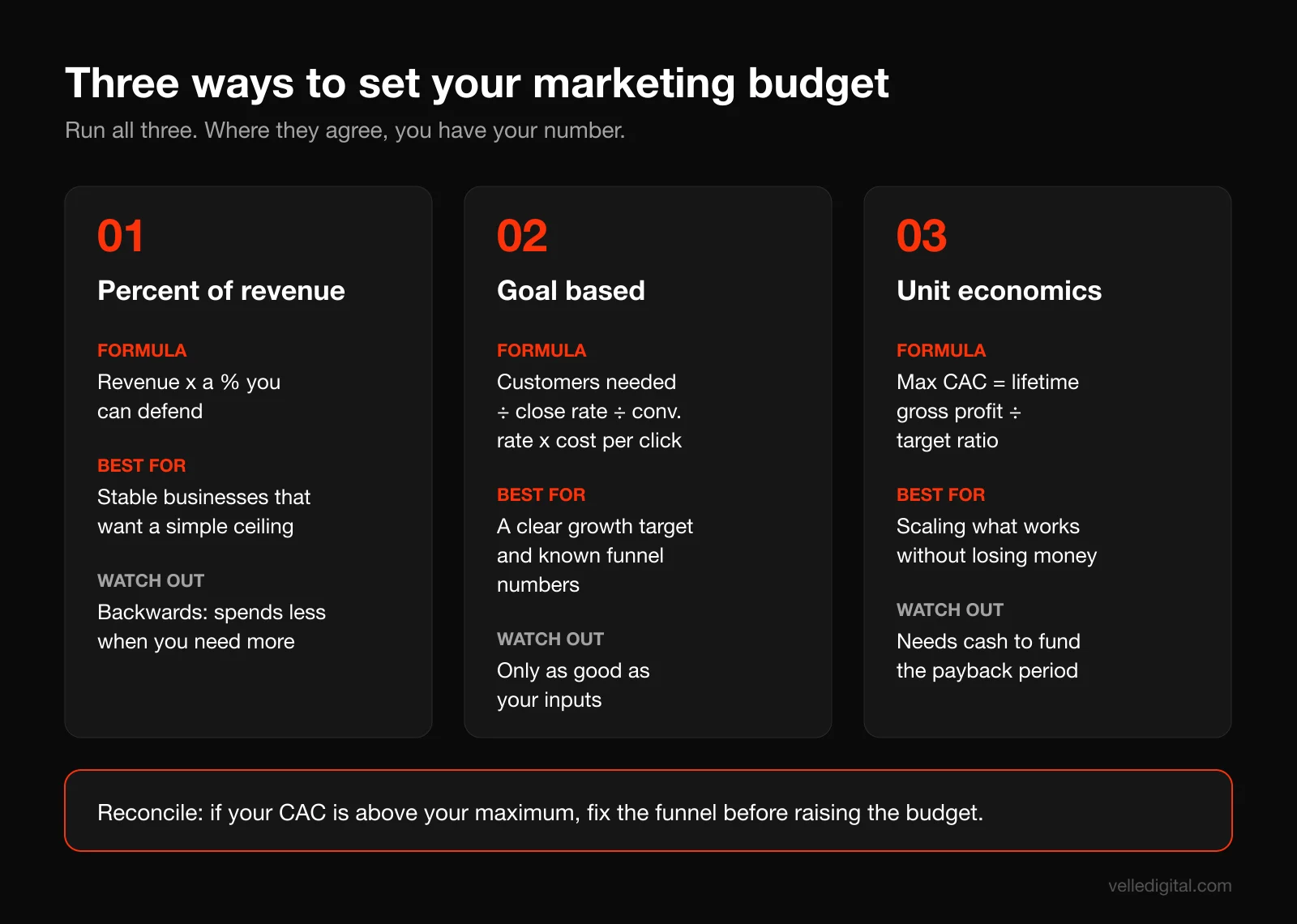
Method 1: Percent of revenue
You take last year's revenue (or this year's forecast) and allocate a fixed share of it to marketing.
How to do it:
- Pull your trailing 12 months of revenue from your accounting software.
- Pull your gross margin (revenue minus the direct cost of delivering the work, divided by revenue).
- Decide whether you are in maintain mode or growth mode this year.
- Pick a percentage you can defend from your margin and your growth goal, not from a blog post.
- Divide by 12 for a monthly figure, then adjust for seasonality (covered below).
Hypothetical example: a landscaping company did 900,000 dollars in revenue last year at a 45 percent gross margin. The owner wants steady growth, not a land grab, and decides on 5 percent. That is 45,000 dollars a year, or 3,750 dollars a month on average. The percentage is the owner's choice for illustration, not a benchmark.
About benchmarks: you will find many specific percentages quoted online, often attributed to sources that no longer publish them. Surveys of marketing leaders such as The CMO Survey, run out of Duke University's Fuqua School of Business, do track spending as a share of revenue, but their respondents are companies large enough to employ a marketing executive, which is not your situation. Use published figures as background, never as your budget.
The weakness of this method: it is backwards. It sets spending based on past revenue, so a struggling business spends less precisely when it needs more customers, and a fast-growing one may underfund the growth it could have had. It also ignores whether the money is working.
Use it when: you have stable revenue history, you want a ceiling that keeps marketing proportional, or you need a quick number for an annual plan.
Method 2: Goal based (work backward from the target)
You start from the number of new customers you need, then work back through your funnel to the spend required to produce them. This is the method we use most often with local service businesses, because it ties every dollar to an outcome.
How to do it:
- Set the revenue goal from new customers. Not total revenue, only the part that must come from customers you do not have yet.
- Divide by average first-year revenue per new customer to get the number of new customers needed.
- Divide by your close rate (the share of qualified leads who buy) to get leads needed.
- Divide by your lead conversion rate (the share of website visitors or ad clicks who become leads) to get clicks or visits needed.
- Multiply by your expected cost per click to get ad spend needed.
- Add your fixed costs (tools, retainer, content) to get the total budget.
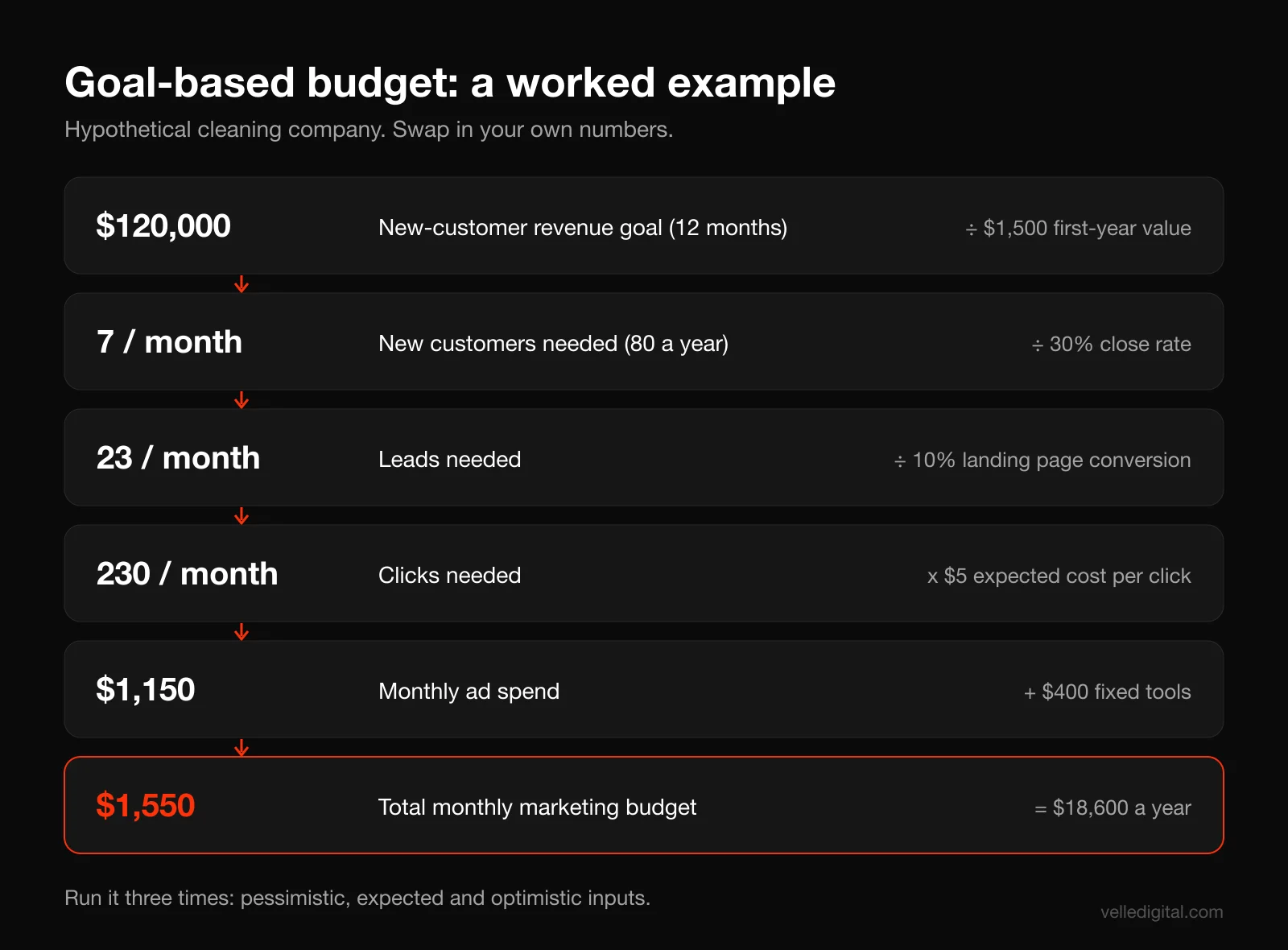
Hypothetical example: a residential cleaning company wants 120,000 dollars in new-customer revenue over the next 12 months. A new recurring client is worth about 1,500 dollars in their first year.
- New customers needed: 120,000 divided by 1,500 = 80 customers, or about 7 a month.
- Close rate on quote requests: 30 percent. Leads needed: 7 divided by 0.30 = about 23 a month.
- Landing page conversion rate: 10 percent. Clicks needed: 23 divided by 0.10 = 230 a month.
- Expected cost per click: 5 dollars. Ad spend: 230 times 5 = 1,150 dollars a month.
- Fixed costs (CRM, email tool, website care plan): 400 dollars a month.
- Total: about 1,550 dollars a month, or 18,600 dollars a year.
Where do the inputs come from? Your close rate and average customer value come from your CRM or invoices. Your conversion rate comes from your analytics. Your cost per click is the one most owners guess at. Keyword Planner, a free tool inside Google Ads, gives bid and traffic estimates for the searches you care about, which is far better than guessing. If you have never run ads, treat those estimates as a range and plan to correct them in the first month.
The weakness of this method: it is only as good as the inputs. If your real close rate is 15 percent, not 30, your lead target doubles and so does the budget. The fix is to run the math with a pessimistic, expected and optimistic version of each input, and fund the expected case with enough cushion to survive the pessimistic one.
Use it when: you know (or can estimate) your funnel numbers and you have a specific growth target.
Method 3: Unit economics (customer acquisition cost and lifetime value)
This method asks how much you can afford to pay for a customer, then lets the budget scale to however many customers you can buy at that price. It is the most powerful of the three and the one owners skip most often.
Two numbers drive it.
- Customer acquisition cost (CAC): total marketing and sales cost in a period divided by the number of new customers won in that period. Use the fully loaded number (ads plus tools plus retainers plus content), not just ad spend.
- Customer lifetime value (LTV): the gross profit a typical customer generates over the whole relationship. Use gross profit, not revenue. A 2,000 dollar job that costs you 1,400 dollars to deliver is worth 600 dollars to your marketing budget, not 2,000.
How to calculate LTV for a small business:
- Average order or job value.
- Times gross margin percentage.
- Times the average number of purchases per customer over their lifetime (use what your records actually show; if you have under two years of data, cap it at what you have seen so far).
- Add referral value only if you track referrals reliably. Otherwise leave it out and treat it as upside.
Then set your maximum affordable CAC. The ratio you target depends on cash flow and risk appetite. Businesses that get paid upfront and have high repeat rates can run a thinner ratio. Businesses with long payment cycles or one-time purchases need a fatter one. In our experience, owners sleep best when lifetime gross profit is several times what they paid to acquire the customer, and when the first purchase alone recovers a meaningful share of the acquisition cost.
Hypothetical example: an HVAC company averages a 400 dollar service call at a 50 percent gross margin. Customers on their maintenance plan come back about three times over their relationship.
- LTV in gross profit: 400 times 0.50 times 3 = 600 dollars.
- If the owner wants lifetime gross profit to be at least three times CAC, maximum CAC is 600 divided by 3 = 200 dollars.
- Their fully loaded marketing cost last quarter was 9,450 dollars and produced 30 new customers. Actual CAC: 315 dollars.
That gap is the whole story. At 315 dollars, each new customer returns less than two times what it cost to acquire. The owner does not need a bigger budget. They need a lower CAC (better conversion, a tighter ad account, fewer fixed tools) or a higher LTV (getting more customers onto the maintenance plan), and only then more spend.
Payback period: the cash flow check
Unit economics can look great on paper while the bank account runs dry. Payback period is the number of months until a new customer's gross profit covers what you paid to win them.
Payback period = CAC divided by monthly gross profit per customer.
Hypothetical example: a 250 dollar CAC and a customer who generates 50 dollars of gross profit a month means a 5 month payback. During those five months, you are funding the gap out of cash. If you plan to double your ad spend, you are doubling the size of that gap. Make sure your cash reserves (or your line of credit) can carry it.
Decision rules:
- If payback is under 3 months, spend can usually scale quickly, as long as quality holds.
- If payback is 3 to 12 months, scale in steps and watch cash.
- If payback is longer than 12 months, fix conversion or pricing before increasing spend, unless you have outside capital and a deliberate plan.
How to reconcile the three methods
Run all three, then compare.
- If goal based is higher than percent of revenue: your growth target is aggressive relative to your current size. Either accept a bigger investment year, lower the target, or improve conversion so each dollar works harder.
- If percent of revenue is higher than goal based: you can hit your target for less than you thought. Bank the difference or raise the target.
- If unit economics says your CAC is above your maximum: do not raise the budget yet. Fix the funnel first. Spending more at a losing CAC loses money faster.
- If all three land in roughly the same place: you have your number.
Step-by-step: build your small business marketing budget in a weekend
Here is the full process, in order. Block out a few hours, open your accounting software and your CRM, and work through it.
Step 1: Pull your real numbers
Collect 12 months of data where you have it.
- Revenue by month.
- Gross margin by service or product line.
- Number of new customers by month.
- Total marketing spend by month, split into the four buckets above.
- Lead count by source, if your CRM tracks it.
- Close rate (won deals divided by qualified leads).
- Average job or order value, and repeat purchase rate.
If you do not have lead source data, write that down as the first thing to fix. You cannot budget well for channels you cannot see. A simple CRM with a required "how did you hear about us" field is enough to start. If your lead handling lives in an inbox and a notebook, our guide to setting up a CRM for a small business walks through the basics.
Step 2: Calculate CAC, LTV and payback
Use the formulas above. Do it per channel if you can, and blended across all channels regardless. Blended CAC (total marketing cost divided by total new customers) is the most honest number you have, because it cannot be gamed by attribution settings.
Step 3: Set the target and run the goal-based math
Write down the new-customer revenue target, then run the funnel math three times with pessimistic, expected and optimistic inputs. Write all three versions down.
Step 4: Check it against percent of revenue and cash
Compare your goal-based number to a percentage of revenue you are comfortable with. Then check payback against your cash reserves. If the goal-based number exceeds both, you are planning a growth push: decide whether that is intentional and fundable.
Step 5: Split fixed and variable costs
List every tool and service you pay for. For each one, ask: did this directly contribute to a customer in the last 90 days, or is it required for something that did? Anything that fails both questions goes on the cut list. What remains is your fixed base. Everything else in the budget is variable spend.
Step 6: Allocate across channels by stage
Use the stage guidance in the next section to split variable spend between capturing demand, creating demand and retaining customers.
Step 7: Reserve a testing budget
Set aside a slice of variable spend for experiments, separate from proven campaigns. Details in the testing section below.
Step 8: Map the year by month
Spread the annual number across 12 months according to your seasonality, not evenly. Details below.
Step 9: Set your tracking and review rhythm
Decide which numbers you will look at weekly, monthly and quarterly, and who looks at them. A budget without a review schedule is a guess.
Step 10: Write down the cut order before you need it
Decide now what goes first if revenue dips. You will make a better decision calmly in October than in a panic in February.
How to split your marketing budget between channels by business stage
There is no universal channel mix. The right split depends on how established you are, how much demand already exists for what you sell, and how long your sales cycle is. Here is how we think about it, using four jobs that marketing does.
- Foundations: website, tracking, Google Business Profile, CRM, brand basics. Without these, every other dollar leaks.
- Demand capture: reaching people who are already looking. Search ads, local SEO, directories, review sites.
- Demand creation: reaching people who are not looking yet. Social ads, video, content, sponsorships, partnerships.
- Retention and referral: getting existing customers to buy again and send friends. Email, reviews, loyalty offers, follow-up automation.
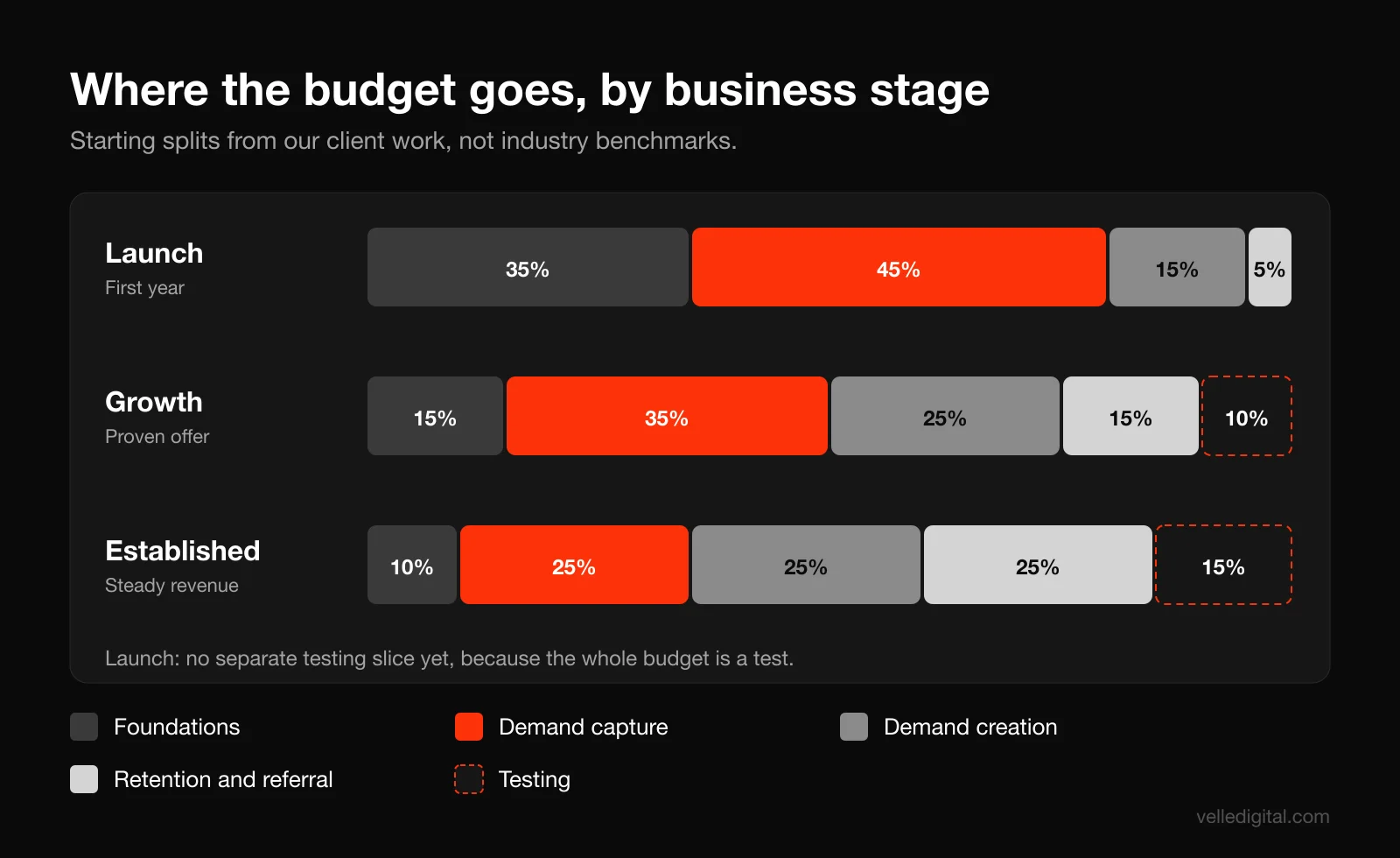
The percentages in the figure are our starting points from client work, not industry benchmarks. Treat them as a first draft that your own data will overwrite within a quarter or two.
Stage 1: Launch (first year, or under a few hundred customers)
Your priority is proof: can you acquire customers profitably at all? Spend a heavy share on foundations, because a weak website or missing tracking will make every later channel look worse than it is. Then put most variable spend into demand capture, because people already searching for your service convert fastest and teach you the most about your offer.
- Get the website converting before you scale traffic to it. If you are weighing a rebuild, our website cost guide explains what each tier buys you.
- Claim and complete your Google Business Profile, then start a review habit from customer one.
- Run one search campaign on your highest-intent services. Our Google Ads guide for small businesses covers the setup step by step.
- Keep demand creation small and focused on one channel.
Stage 2: Growth (proven offer, ready to scale)
You know what a customer costs and what they are worth. Now the job is to scale the channels that work and add a second one. Foundations drop to maintenance level. Demand capture stays strong. Demand creation grows, because search volume for any local service has a ceiling and you will hit it. Retention starts to earn real budget, because your customer list is now an asset.
- Add a paid social channel to reach people before they search. If you are deciding between platforms, our comparison of Facebook ads versus Google ads lays out when each one wins.
- Start a regular email to past customers. It is the cheapest repeat revenue you will ever buy.
- Invest in local SEO, which compounds slowly but lowers your blended CAC over time.
Stage 3: Established (steady revenue, defending and expanding)
You have multiple channels and a customer base. The risk now is complacency: paying for channels out of habit. Retention and referral deserve a much bigger share, because your existing customers are your cheapest growth. Demand creation also earns more, because brand familiarity makes every other channel cheaper. Keep a meaningful testing budget so you find the next channel before the current ones plateau.
- Build a proper full-funnel marketing strategy so awareness, consideration and conversion spending support each other instead of competing.
Decision rules for channel allocation
- If you cannot track leads by source, spend on tracking before spending on any new channel.
- If a channel has run for 90 days with clean tracking and a CAC above your maximum, cut it or restructure it. Do not keep feeding it hoping it turns around.
- If a channel's CAC is well under your maximum and it is not limited by volume, increase spend in steps of 20 to 30 percent and recheck after two to four weeks. Big jumps disrupt platform algorithms and muddy your read on what changed.
- If your sales cycle is longer than 60 days, judge channels on qualified leads and pipeline value first, closed revenue second, or you will cut good channels before their results arrive.
- If most of your customers come from referrals, put more into retention and review generation, not less. That is your best channel telling you where to invest.
Set your ad budget correctly inside the platforms
Owners lose money not only on the overall number but on how they enter it into the ad platforms. Two practical notes.
Google Ads works on an average daily budget
Google Ads campaigns use an average daily budget, not a monthly cap you type in. Google's help article on setting an average daily budget says that if you are working with a monthly budget, divide it by 30.4 to get the daily figure. So a 1,520 dollar monthly search budget becomes a 50 dollar average daily budget.
Spend will not be identical every day. Google can spend more than your average on busy days and less on quiet ones, so plan around the monthly figure, and do not panic when one Tuesday spends more than you expected.
Meta works on campaign or ad set budgets
Meta lets you set daily or lifetime budgets at the campaign or ad set level. Its overview of ad budgets explains the options. The practical point for budgeting: Meta's delivery system goes through a learning phase after you launch or significantly edit an ad set, and frequent budget changes can restart it. That is one more reason to change budgets in measured steps rather than daily swings. For a deeper walkthrough of running these campaigns for a local business, see our guide to Meta ads for local service businesses.
How much to spend on testing
Every budget needs a slice for experiments: a new channel, a new offer, a new audience, a new landing page. Without it, you only ever optimize what you already do, and you find out a channel has plateaued after it has already cost you.
Our rule of thumb: once you have at least one channel working profitably, reserve roughly 10 to 15 percent of variable spend for testing. Before that, everything is a test, so the whole variable budget works as one.
How to size a single test
A test that is too small tells you nothing. Size it from the result you need to see, not from what feels comfortable.
- Decide the success metric (cost per lead, cost per booked appointment, cost per sale).
- Decide the target: the most you would pay per result for this to be worth scaling.
- Decide how many results you need to trust the outcome. For small budgets we look for at least 15 to 30 conversions before calling a test, more if results are close.
- Test budget = target cost per result times results needed.
Hypothetical example: a dental clinic wants to test Meta ads for new-patient bookings. Target cost per booking: 80 dollars. Results needed: 20. Test budget: 1,600 dollars, spread over four to six weeks. If the clinic can only spare 400 dollars, it should not run the test yet, because 400 dollars can buy at most five bookings at target, which is not enough to separate a good channel from a lucky week.
Rules for running tests
- Change one major variable at a time (channel, audience, offer or landing page), or you will not know what caused the result.
- Write down the success criteria and the end date before you start. Decide in advance what result means scale, iterate or kill.
- Use the platforms' built-in experiment tools where they exist. Meta's A/B testing feature splits audiences so two versions do not compete for the same people.
- Give tests enough time to cover at least one full sales cycle for your business.
- Graduate winners into the main budget and free up the testing slice for the next idea.
Plan for seasonality
Very few small businesses have flat demand. Landscapers, HVAC, tax preparers, wedding vendors, retailers and roofers all have obvious peaks. Even businesses that think they are flat usually have a slow summer or a quiet December. An evenly spread budget overspends in slow months and underspends in the months that matter.
Step-by-step: build a seasonal budget calendar
- Pull 2 to 3 years of revenue and lead volume by month. Calculate each month's share of the annual total.
- Check search demand. Google Trends shows relative search interest over time for your service and region. It is relative, not absolute, so use it for the shape of the year, not for volume.
- Weight your variable spend to the shape of demand. If April to June produces 40 percent of your leads, that quarter should get roughly that share of ad spend, adjusted for the lead times below.
- Spend ahead of the peak. If customers research for three weeks before booking, your ad spend needs to rise three weeks before your busiest booking period. Demand creation channels need even more lead time.
- Keep a floor in the off season. Do not turn everything off. Keep search ads on your highest-intent terms, keep your email list warm and keep collecting reviews. Restarting from zero costs more than idling.
- Hold fixed costs steady. Seasonality applies to variable spend. Your CRM and website do not get cheaper in January.
Hypothetical example: a pool service company with a 60,000 dollar annual ad budget might put 6,000 dollars a month into March through August, when people open and maintain pools, and 4,000 dollars a month across September through February, with most of that going to search terms like pool closing and repair. The total stays the same. The timing follows the customer.
Short promotions and sales events
For short events like a three-day sale, Google Ads offers seasonality adjustments, which tell Smart Bidding to expect a change in conversion rate. Google notes they are intended for major expected changes during short events of about 1 to 7 days, because Smart Bidding already handles normal seasonal patterns. For most small businesses, the simpler move is to raise the daily budget for the event and bring it back down after.
Track your return so the budget gets smarter every month
The budget you set today is a hypothesis. Tracking is how you find out whether it was right. You do not need an enterprise analytics stack. You need four things set up properly.
The minimum tracking setup
- UTM tags on every link you control. UTM parameters (utm_source, utm_medium, utm_campaign) added to your links tell Google Analytics where each visit came from, so traffic from your emails, social posts and ads is labeled by source and campaign.
- Conversion tracking in each ad platform, firing on the actions that matter: form submits, calls, bookings, purchases.
- A source field in your CRM that is filled in for every lead, ideally automatically from form data, with a manual "how did you hear about us" backup.
- Call tracking if phone calls are a big share of your leads. Calls are where most local service businesses lose attribution.
The monthly marketing scorecard
Copy this into a spreadsheet. Fill in one row per channel plus a total row, every month.
- Spend (ads plus any channel-specific tools and fees)
- Leads
- Cost per lead (spend divided by leads)
- Qualified leads
- New customers
- CAC (spend divided by new customers)
- Revenue from new customers
- Gross profit from new customers
- Return on spend (gross profit divided by spend)
- Notes (what changed this month)
Look at three numbers first: blended CAC, return on spend, and lead volume. If blended CAC is rising, find the channel responsible. If lead volume is falling while CAC holds, you are likely budget limited or seasonal. If both look fine but revenue is flat, the problem is downstream: sales follow-up, close rate or pricing.
Platform numbers versus your numbers
Ad platforms report conversions using their own attribution rules, and each one tends to claim credit generously. Add up the conversions every platform reports and you will often get more than the leads in your CRM. Trust your CRM and your bank account over the dashboards. Use platform data to optimize inside the platform, and use blended CAC to decide budget.
Review rhythm
- Weekly (15 minutes): spend pacing against plan, any campaign spending with zero leads, lead response times.
- Monthly (1 hour): scorecard, channel CAC against maximum, decisions to shift budget between channels.
- Quarterly (half a day): rerun the three budget methods with fresh numbers, review fixed costs and tools, review test results, update the seasonal calendar.
If you would rather have someone independent go through your spend and tracking, our marketing audit does exactly this review and hands you a prioritized list of fixes.
What to cut first when money gets tight
Every business hits a lean stretch. The worst response is cutting marketing evenly across the board, or cutting the channels that produce customers while keeping the comfortable ones. Here is the order we recommend, from first to cut to last.
- Anything you cannot measure and cannot explain. Sponsorships you renewed out of habit, directory listings nobody can attribute a lead to, boosted posts with no goal.
- Unused and overlapping tools. Two email platforms, a social scheduler nobody logs into, a design subscription used twice a year. Cancel or downgrade.
- Campaigns and ad sets above your maximum CAC. Cut the worst performers inside each channel before you cut whole channels.
- Broad awareness spend with no clear path to leads. If you need to protect cash, pause demand creation before demand capture.
- Content production beyond what keeps your channels fed. Pause new blog posts and shoots, keep what is already working live.
- Testing budget. Pause tests in a genuine cash crunch, but restart them as soon as you can.
- Retainers that are not tied to results. Renegotiate scope before cancelling outright; a lighter engagement often beats starting over later.
Protect these until the very end:
- High-intent search ads on your best services. These are customers raising their hand right now.
- Retention and email to past customers. It is nearly free revenue and the hardest to rebuild if your list goes cold.
- Tracking and your CRM. Cutting measurement to save a little money guarantees worse decisions with all the rest.
- Your website and Google Business Profile. Every other channel sends people there.
Decision rule: when you cut, cut variable spend in the worst channels first and fixed costs you are not using second. Never cut the thing that tells you what is working.
Common marketing budget mistakes
These are the patterns we see over and over when we review small business marketing spend.
- Using revenue instead of gross profit for LTV. It makes every channel look more profitable than it is and leads to overspending.
- Ignoring fixed costs in CAC. Ad-only CAC looks great. Fully loaded CAC is what your bank account feels.
- Spreading too thin. Five channels at 300 dollars each usually produce less than one channel at 1,500 dollars, because none of the five gets enough data to optimize.
- Changing budgets daily. Platforms need stable conditions to learn. Make changes in steps, then wait.
- Judging too early. Two weeks of data on a channel with a 45 day sales cycle tells you nothing about closed revenue.
- Judging too late. Three months of spend with no leads and clean tracking is an answer. Act on it.
- Sending paid traffic to a weak page. A landing page that converts at 2 percent costs twice as much per lead as one at 4 percent for the same traffic. Fixing the page is often the cheapest budget increase you can make.
- Slow lead follow-up. Paying for leads and then calling back the next day wastes the spend. Response speed is a budget issue.
- No off-season floor. Turning everything off in the slow months, then paying to rebuild momentum every spring.
A small business marketing budget template you can copy
Copy this structure into a spreadsheet. Fill in the inputs first, then the monthly plan. Every figure in brackets is a placeholder.
Part 1: Inputs
- Trailing 12 month revenue: [ ]
- Gross margin percentage: [ ]
- New-customer revenue target for the next 12 months: [ ]
- Average first-year revenue per new customer: [ ]
- Average job or order value: [ ]
- Average purchases per customer over their lifetime: [ ]
- Close rate (qualified leads to customers): [ ]
- Lead conversion rate (visits or clicks to leads): [ ]
- Expected cost per click or cost per lead by channel: [ ]
- Target LTV to CAC ratio: [ ]
- Cash reserve available to fund payback: [ ]
Part 2: Calculations
- LTV (gross profit) = average job value times gross margin times lifetime purchases
- Maximum CAC = LTV divided by target ratio
- New customers needed = new-customer revenue target divided by first-year revenue per customer
- Leads needed = new customers divided by close rate
- Clicks needed = leads divided by lead conversion rate
- Variable spend needed = clicks times cost per click (or leads times cost per lead)
- Percent of revenue check = total budget divided by trailing revenue
- Payback period = CAC divided by monthly gross profit per customer
Part 3: Fixed costs (monthly)
- CRM and sales tools: [ ]
- Email marketing platform: [ ]
- Website hosting and maintenance: [ ]
- Call tracking and analytics tools: [ ]
- Agency or freelancer retainers: [ ]
- Other subscriptions: [ ]
- Total fixed: [ ]
Part 4: Variable spend (monthly, by channel)
- Search ads: [ ]
- Social ads: [ ]
- Local SEO and directories: [ ]
- Email and retention offers: [ ]
- Content and creative: [ ]
- Testing reserve: [ ]
- Total variable: [ ]
Part 5: Monthly plan
Columns: Month | Seasonal weight (share of annual demand) | Fixed costs | Variable spend | Total | Planned leads | Planned customers | Actual spend | Actual leads | Actual customers | Actual CAC | Notes
Fill the planned columns now, the actual columns every month, and compare them at each quarterly review. If you would like a second pair of eyes on your numbers before you commit, you can book a call with our team.
Marketing budget checklist
Run through this before you finalize the year, and again at each quarterly review.
- I know my gross margin by service or product line.
- I have calculated LTV using gross profit, not revenue.
- I know my fully loaded, blended CAC for the last quarter.
- I have set a maximum CAC and a target payback period.
- I ran the goal-based math with pessimistic, expected and optimistic inputs.
- I compared the result to a percentage of revenue I can defend.
- I checked payback against my cash reserves.
- I separated fixed costs from variable spend and cut unused tools.
- My channel split matches my business stage.
- I have reserved a testing budget, sized from the results I need.
- My monthly budget follows my seasonality, with spend rising ahead of peaks.
- I keep a floor of high-intent search, email and reviews in the off season.
- Every link I control is UTM tagged and every lead has a source in my CRM.
- Conversion tracking fires on real leads, calls and sales in each ad platform.
- I have a weekly, monthly and quarterly review on the calendar.
- I wrote down my cut order before I needed it.
Frequently asked questions
How much should a small business spend on marketing?
Enough to win the customers you need at a cost your margins can carry. Work out how much a customer is worth in gross profit, set the most you will pay to acquire one, then multiply by the number of new customers you need and add your fixed costs. Check the result against a percentage of revenue and your cash flow before committing.
Is there a standard percentage of revenue for a small business marketing budget?
There is no single standard that fits every business. Published figures usually come from surveys of larger companies or from guidance that is not tied to your margins. A percentage is useful as a ceiling or a sanity check, but your gross margin, close rate and repeat rate should decide your number.
How do I calculate customer acquisition cost?
Add up all marketing and sales costs for a period, including ad spend, tools, retainers and content, and divide by the number of new customers won in the same period. Calculate it per channel where you can and blended across all channels regardless. The blended number is the most reliable, because it does not depend on attribution settings.
What is a good LTV to CAC ratio for a small business?
It depends on your cash flow and how quickly customers pay you back. Businesses with upfront payment and strong repeat business can run a thinner ratio, while one-time purchases or long payment cycles need more room. Whatever ratio you choose, calculate LTV from gross profit, not revenue, and check payback period alongside it.
How should a new business budget for marketing with no data?
Start with foundations (a converting website, tracking, a CRM and a complete Google Business Profile), then put most of your variable spend into one demand capture channel such as search ads. Use Keyword Planner estimates and conservative assumptions for your first goal-based math, and plan to replace every assumption with real data within 60 to 90 days.
Should I spend more on marketing in slow months?
Usually not more, but do not go to zero. Keep a floor of high-intent search ads, email to past customers and review collection, and raise spend a few weeks before your busy season, since customers research before they buy. Turning everything off and restarting each year costs more than idling.
How much of my marketing budget should go to an agency?
Agency fees are part of your fixed costs, so judge them the same way: they should lower your CAC or raise your lead volume by more than they cost. If retainers and tools outweigh your ad spend for more than a couple of quarters, the setup is top heavy. Rebalance toward spend that buys customers or toward a scope that matches your size.
What marketing should I cut first if cash is tight?
Cut spend you cannot measure, unused tools and the worst-performing campaigns first. Protect high-intent search ads, email to existing customers, your tracking and your website until the very end. Never cut the thing that tells you what is working.
Get a second opinion on your marketing budget
A good small business marketing budget is not a percentage you copy. It is a set of numbers you understand: what a customer is worth, what you can pay for one, and where each dollar is going. If you want an outside look at where your current spend is leaking and where it should go next, start with a Velle marketing audit, or book a strategy call and bring your numbers.