How to Choose a Marketing Agency: 25 Questions to Ask First
An honest buyer's guide from an agency: decide what you need, compare agency types and pricing models, spot red flags, ask the 25 questions that matter and read the contract before you sign.
Here is how to choose a marketing agency in one paragraph: decide what outcome you need and what you can spend before you talk to anyone, pick the type of help that fits that outcome (freelancer, specialist, full service or in-house), shortlist three agencies that have done your kind of work, check their case studies and call their references, understand what their pricing model rewards, rule out anyone who wants to own your accounts or lock you into a long contract, ask the 25 questions below, and read the contract before you sign. Then hold them to a written 90-day plan.
We are an agency, so read this with that in mind. But we would rather you hire the right partner, even if it is not us. This guide is the advice we give friends who ask us how to choose a marketing agency: what to decide first, how to compare options fairly, the questions that separate good agencies from good salespeople, the red flags, the contract clauses that protect you, and when to walk away.
How to choose a marketing agency in 9 steps
If you only read one section, read this one. Each step has its own detailed section below.
- Define the job. Write down the business outcome, the budget and what you can handle in-house.
- Pick the right type of help. Match the job to a freelancer, a specialist agency, a full service agency or an in-house hire.
- Build a shortlist of three. Use referrals, proof of similar work and fit, not ad spend or awards.
- Evaluate case studies. Look for the starting point, what they did, the business result and a named client you can verify.
- Call references. Ask the uncomfortable questions, using the script below.
- Understand the pricing model. Know what a retainer, a project fee and a performance deal each reward.
- Screen for red flags. Account ownership, lock-in, guarantees and vanity reporting are the big four.
- Read the contract. Ownership, term, termination, scope and reporting clauses matter most.
- Run a structured first 90 days. Access, audit, plan, launch, review, in that order.
Step 1: Decide what you actually need before you talk to anyone
Most bad agency relationships start before the first meeting. The owner knows they need "more leads" or "better marketing," talks to five agencies, and ends up buying whatever the most persuasive salesperson happens to sell. If you cannot describe the job, you cannot judge who does it best.
Spend one hour on the following before you contact anyone.
Write down the business outcome, not the tactic
"We need SEO" is a tactic. "We need 30 more qualified quote requests a month for kitchen renovations in our service area" is an outcome. The second one lets an agency tell you whether SEO, Google Ads, a better website or all three is the right answer, and it gives you something to measure them against later.
A good outcome statement has four parts: what you want more of, how much more, by when, and how you will measure it. If you do not know your current numbers, that is fine, but say so. Finding the baseline becomes part of the first month's work.
Know your numbers (roughly)
You do not need a finance degree. You need three figures, even rough ones:
- Average customer value. What a typical new customer is worth in revenue over the first year.
- Close rate. Out of 10 leads, how many become customers.
- What you can afford to pay for a customer. Usually some fraction of the gross profit on that first-year value.
Worked example (hypothetical numbers): a landscaping company has an average first-year customer value of 4,000 dollars, a 40 percent gross margin and closes 3 out of 10 leads. Gross profit per customer is 1,600 dollars. If the owner is willing to spend up to a quarter of that to win a customer, the target cost per customer is 400 dollars, which means the target cost per lead is about 120 dollars (400 times 0.3). Now every agency pitch can be judged against one question: can you get us leads under 120 dollars that close at our usual rate?
Set a total budget, then split it
Your marketing budget has two parts: what you pay the agency (fees) and what goes into media and production (ad spend, photography, software). Agencies quote fees. Many owners forget the second half and end up with a well-managed campaign that has no money to run. If you have not set a number yet, our guide to building a small business marketing budget walks through it.
A simple decision rule: if your total budget is small enough that agency fees would eat more than about half of it, you are probably better served by a freelancer, a one-off project, or doing the basics yourself until revenue grows.
Be honest about your internal capacity
Who on your side will approve ads, supply photos and follow up with the leads? Agencies fail quietly when the client cannot respond within a few days. If nobody owns marketing internally, assign a person before you sign.
Copy this one-page brief
Fill this in and send it to every agency on your shortlist.
- About us: what we sell, where, and to whom (two or three sentences).
- Goal: the outcome, the number and the timeframe.
- Current state: what we do today, what has worked, what has not, and current numbers if we have them.
- Budget: monthly or project fee range, plus separate media budget.
- Internal team: who will be the day-to-day contact and how much time they have.
- Assets we have: website, ad accounts, CRM, brand guidelines, photos, past reports.
- Decision date: when we will choose and when we want to start.
- What we need from you: your recommended approach, a rough 90-day plan, pricing, two relevant case studies and two references.
Step 2: Choose the right type of marketing help
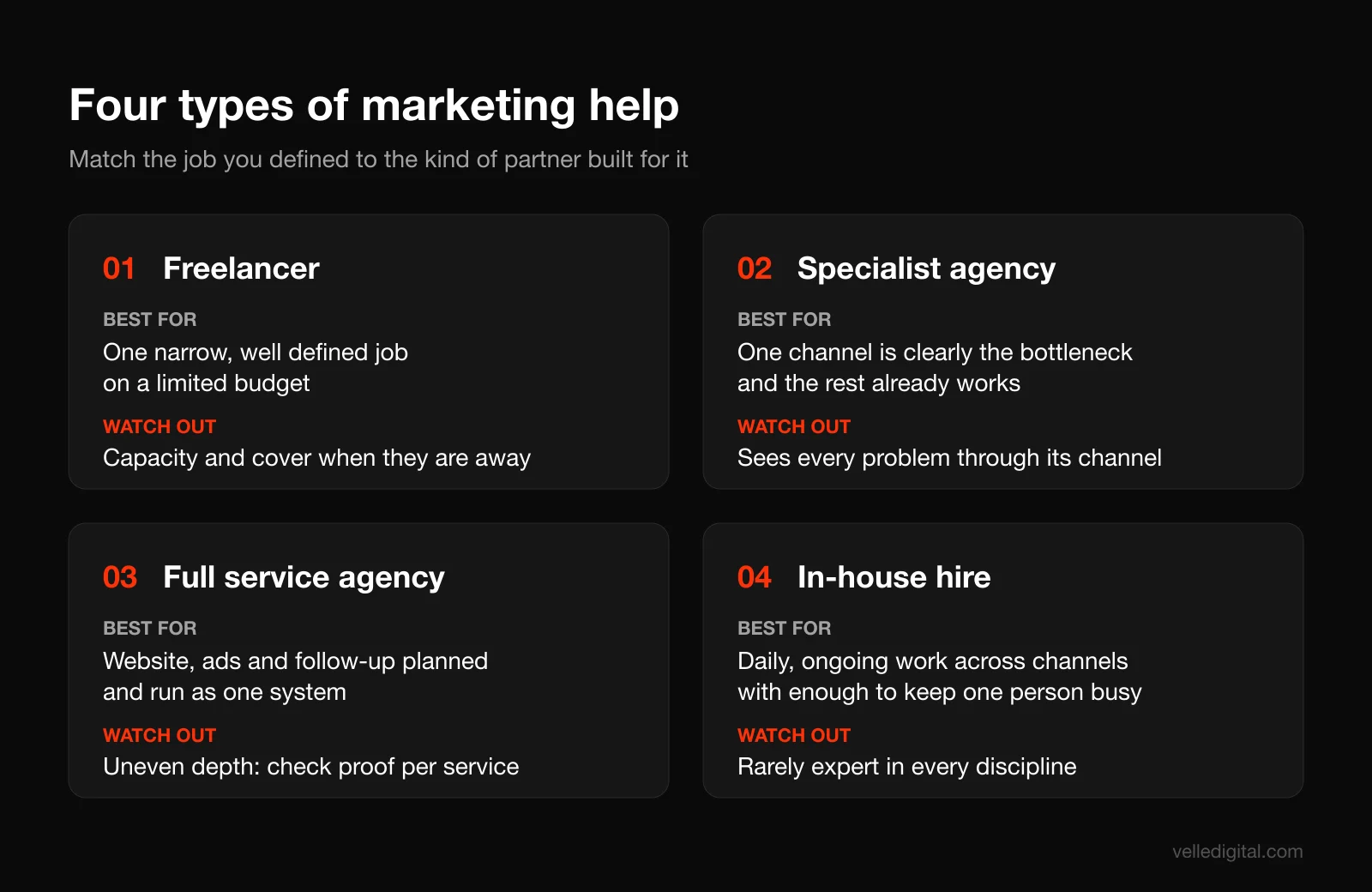
"Marketing agency" covers everything from a single consultant to a 300-person firm. The right choice depends on the job you defined in step 1, not on which option sounds most impressive.
Freelancer or independent consultant
One skilled person, usually focused on one discipline: ads, SEO, design, copywriting or email. You get direct access to the person doing the work and the lowest overhead.
Choose a freelancer when the job is narrow and well defined, your budget is limited, and you are comfortable coordinating the pieces yourself. The trade-off is capacity and continuity. When they get sick, take a holiday or land a bigger client, your work waits.
Specialist agency
A team that does one or two things deeply, such as paid search, SEO or web development. They tend to have strong processes, sharp benchmarks and people who have seen your exact problem many times.
Choose a specialist when one channel is clearly the bottleneck and you already have the other pieces handled. The watch-out is tunnel vision: a paid ads specialist will tend to see every problem as an ads problem. If the real issue is a slow website or a sales team that never calls leads back, they may not tell you, because it is outside their scope.
Full service agency
One team covering strategy, brand, website, content, ads, email and often CRM and automation. You get one point of accountability and channels that are planned together instead of in separate silos.
Choose full service when you need several pieces working together (for example, a new website plus ads plus lead follow-up) and you do not want to project manage three vendors. The watch-out: some full service agencies are excellent at two things and average at the rest. Ask who specifically does each service, whether they are employees or contractors, and look for case studies in each discipline you plan to buy.
In-house marketer
A full-time or part-time employee. They know your business deeply, are always available and build knowledge that stays with you.
Choose in-house when marketing is a constant, daily need and you have enough work to keep one person busy across several channels. The catch is that one person rarely has expert depth in design, development, paid ads, SEO and analytics at once.
Quick decision rules
- If one channel is the problem and everything else works, hire a specialist or a strong freelancer.
- If you need a website, ads and follow-up built together, hire a full service agency.
- If you need daily content, events and internal coordination, hire in-house and add specialists for depth.
- If your budget is under the cost of one part-time employee and the job is narrow, start with a freelancer or a fixed project.
- If you do not know what the problem is, buy a paid audit first, then decide.
That last rule is underrated. A one-time marketing audit costs far less than six months of the wrong retainer, and it gives you a written diagnosis you can take to any agency.
Step 3: Build a shortlist of three
Talking to ten agencies is exhausting and makes comparison harder, not easier. Three serious candidates is the right number. Here is where to find them and how to filter.
Where good candidates come from
- Referrals from businesses like yours. Ask owners in your industry (but not direct competitors) who they use and whether they would hire them again.
- Work you admire. If a local company's website or ads stand out, ask them who built it.
- Platform directories. Google lists companies in its Partners program, and the requirements to become a Google Partner include performance, spend and certification thresholds. It is a useful minimum signal for paid search, not proof of quality.
Filter before the first call
Before you book a call, spend 10 minutes on each agency's site and look for three things. Do they show work similar to what you need? Do they explain how they work, or only how great they are? Can you find real names of people and clients? If you cannot find any of the three, move on.
Watch how they handle the first conversation
The first call tells you a lot. A good agency asks more questions than it answers. It wants to know your margins, your sales process, your competitors and what you have tried. Google's own guidance on hiring an SEO makes the same point: your SEO should ask questions about what makes your business unique, who your competitors are and how your customers find you. If an agency pitches a package before it understands your business, it is selling, not diagnosing.
Step 4: Evaluate case studies and portfolios
Every agency has a portfolio. The useful question is not "is this nice?" but "does this prove they can solve my problem?"
What a strong case study contains
- The starting point. What the client's situation was before, with numbers if possible.
- The specific work. What the agency actually did, not a list of every service they offer.
- A business result. Leads, sales, booked jobs, revenue or cost per customer, not just impressions or followers.
- A timeframe. Results in 3 months and results in 3 years are very different claims.
- A named, checkable client. You should be able to look up the business and, ideally, speak to them.
How to read the numbers critically
Percentages without a base are the most common trick. "Traffic up 300 percent" might mean 100 visitors became 400. "Leads doubled" might mean 4 became 8. Ask for the raw numbers behind every percentage.
Also ask what else changed during that period. If a client's leads went up during their peak season, or after they doubled their ad budget, or after they opened a second location, the agency did not cause all of that growth.
Be aware of selection bias, too. A case study is the best result an agency has, not a typical one. That is fine, but ask what a typical result looks like. The FTC's guidance for advertisers says that when an endorser's results are better than what people generally achieve, the ad should make clear the generally expected results. Apply the same standard to an agency's pitch.
Look past the polish
A beautiful portfolio site proves the agency can make a beautiful portfolio site. Go look at live client work. Visit the websites they built on your phone. Search for their SEO clients' key terms. Look at the ads in the Meta Ad Library or on Google for their paid clients. If live work is noticeably weaker than the portfolio screenshots, that tells you something. You can also browse our client work to see what we mean by showing the actual output.
Step 5: Check references properly
Most people skip reference calls or ask soft questions that get soft answers. A 15-minute call with a current client is the single best predictor of what working with an agency will be like.
Ask for the right references
Ask for two current clients and one former client. Current clients tell you about day-to-day service. A former client who will still speak well of them tells you how the agency behaves when things end, which is when you find out who owns what.
Ask for references similar to you in size, budget and industry. A reference from a client spending ten times your budget tells you how the agency treats its biggest accounts, not how it will treat you.
A reference call script you can copy
- How long have you worked with them, and what do they do for you?
- What has changed in your business since you started, in actual numbers?
- Who do you deal with day to day? Is it the same person who pitched you?
- How quickly do they reply when something breaks?
- Tell me about a time something went wrong. How did they handle it?
- Do you understand their reports? Do the numbers match what you see in your own business?
- Do you own your ad accounts, website and analytics?
- Has the bill ever surprised you?
- What do you wish they did better?
- Would you hire them again if you were starting over today?
The most revealing answers usually come from "tell me about a time something went wrong" and "what do you wish they did better." Every agency makes mistakes. What you want to hear is that they owned it, fixed it and told the client before the client found it.
Step 6: Understand pricing models and what each one incentivizes
How an agency charges shapes how it behaves. No model is perfect. The point is to know what each one rewards so you can guard against its weak spot.
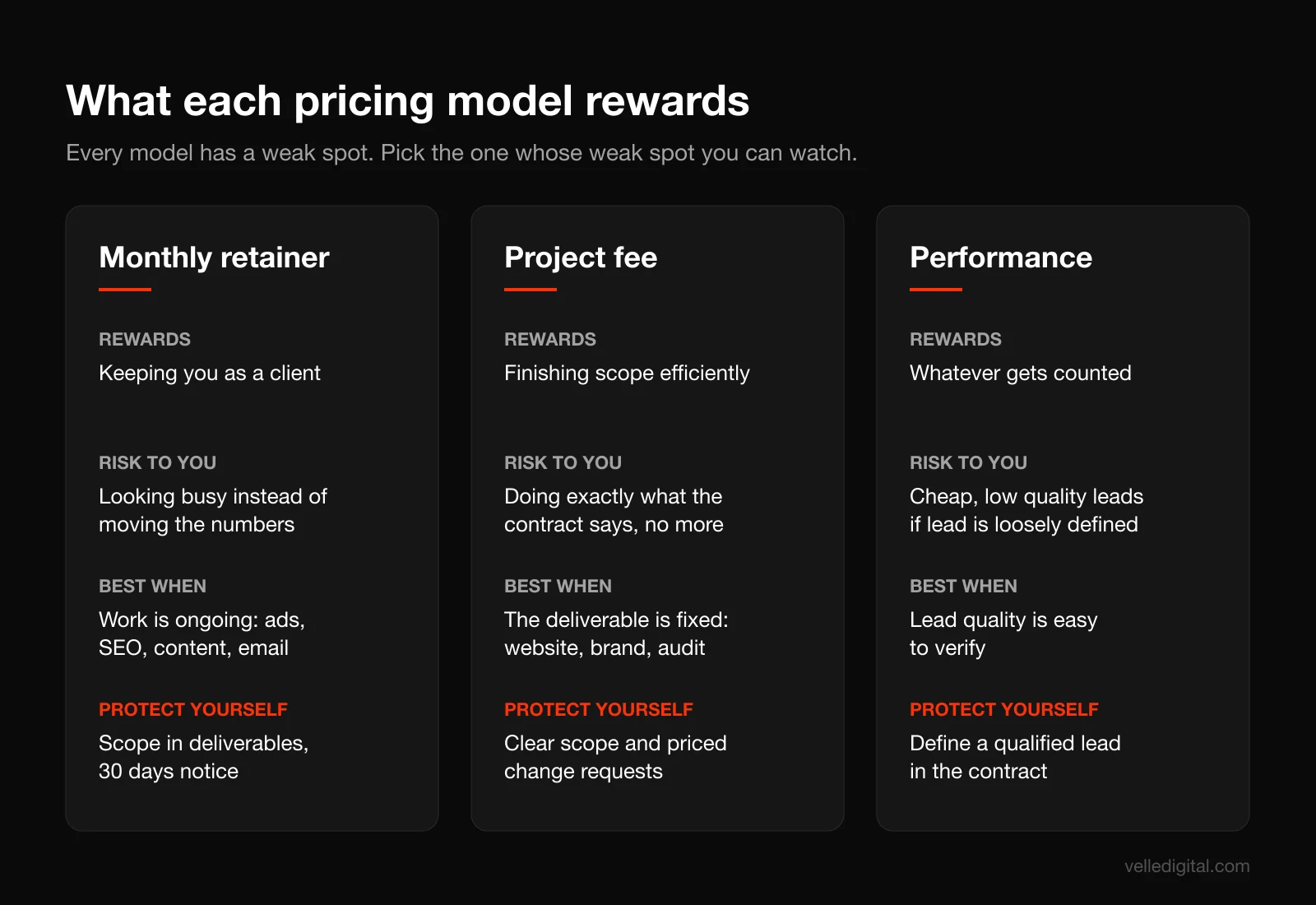
Monthly retainer
You pay a fixed monthly fee for an agreed scope of ongoing work, such as managing ads, producing content or running SEO.
What it rewards: keeping you as a client. A good agency on retainer is motivated to deliver results so you stay. A weak one is motivated to look busy, send long reports and avoid rocking the boat.
How to protect yourself: define the scope in deliverables and outcomes, not just hours. Ask for a monthly summary of what was done, what changed and what is planned next. Make sure the retainer can end with reasonable notice.
Project fee
You pay a fixed price for a defined deliverable: a website, a brand identity, an audit, a campaign launch.
What it rewards: finishing the defined scope efficiently. That is good for budgeting, but it can tempt an agency to do exactly what the contract says and nothing more, or to push back hard on anything that looks like extra scope.
How to protect yourself: invest time in a clear scope document up front, agree on how change requests are priced, and tie payment milestones to approved deliverables. If you are pricing a website project, our website cost guide explains why quotes vary so widely.
Percentage of ad spend
Common in paid media: the management fee is a percentage of what you spend on ads, often with a minimum fee.
What it rewards: spending more of your money. That is not always bad (scaling a profitable campaign is the goal), but it means the agency earns more by recommending a bigger budget whether or not the next dollar is profitable.
How to protect yourself: ask for a flat fee or tiered fee instead, or insist that any budget increase is justified by cost per lead or return on ad spend data. Make sure the ad spend is billed directly to your card in your own account, so you can see exactly what Google or Meta charged.
Performance-based pricing
You pay per lead, per sale or a share of revenue. It sounds like the perfect alignment, and sometimes it is.
What it rewards: whatever is being counted. Pay per lead, and you may get a lot of cheap, low-quality leads. Pay per sale, and the agency needs visibility into your sales process, which many small businesses cannot provide cleanly. Agencies that take on the risk also price it in, so a performance deal often costs more per result than a fixed fee once things are working.
How to protect yourself: define a qualified lead precisely in the contract (service area, budget, service type, a real phone number), agree on how disputes are handled and make sure you still own the accounts and the data.
Worked example: same campaign, three pricing models
Hypothetical numbers for illustration only. A home services company spends 6,000 dollars a month on Google Ads and gets 60 leads.
- Flat fee of 1,500 dollars: total monthly cost 7,500 dollars. If spend rises to 9,000 dollars, the fee stays at 1,500 dollars.
- 15 percent of spend: fee is 900 dollars at 6,000 dollars of spend and 1,350 dollars at 9,000 dollars. Cheaper at first, but the fee grows with every budget increase.
- 40 dollars per lead on top of spend: 2,400 dollars at 60 leads. If lead quality drops but volume rises, you pay more for worse results unless "lead" is defined tightly.
None of these is automatically right. Pick the model whose weak spot you can monitor.
Step 7: Screen for red flags
Most bad agency experiences fall into a handful of patterns. Learn to spot them in the sales process and you will avoid most of the pain.
Red flag 1: They want to own your accounts, domain or website
This is the biggest one, and it is common. The agency creates the Google Ads account, the Meta ad account, the analytics property or even registers your domain under its own name. When you leave, years of data, audiences and conversion history stay with them.
The rule is simple: you own everything, and the agency gets access. Specifically:
- Domain. Registered in your company's name, with your email as the registrant contact, at a registrar account you control. ICANN's registrant guidance says registrants must provide accurate information and keep it up to date and assume sole responsibility for the registration. Make sure that registrant is you.
- Google Ads. Your own account, billed to your card. The agency links its manager account to yours. Google explains how to link an existing account to a manager account, and you control the access level each user gets. Keep at least one admin login for yourself.
- Meta. Your own business portfolio, with your ad account, Page and pixel inside it. You add the agency as a partner rather than letting them own the assets.
- Analytics. Your Google Analytics account, with the agency added as a user. Google's help center explains how to add users and assign roles. Keep administrator access yourself.
- Google Business Profile. You should be the primary owner and the agency a manager. Google's documentation on owners and managers explains the difference.
- Website, hosting and code. Hosting account in your name or transferable on request, plus a copy of the files or repository.
If an agency says it "has to" own the accounts, ask why. A legitimate reason (such as running ads temporarily on a shared account while yours is approved) should come with a written plan to transfer it.
Red flag 2: Long lock-in contracts with no exit
A 12-month minimum with no termination clause protects the agency, not you. Agencies sometimes argue that SEO or brand work takes time to show results, and that is genuinely true. But a good agency can handle that with a reasonable initial term (often three to six months), followed by month-to-month or 30-day notice. If they are confident, they do not need to trap you.
Red flag 3: Guaranteed rankings or guaranteed results
Nobody controls Google's rankings except Google. Google's guidance is direct: no one can guarantee a #1 ranking on Google, and you should be wary of anyone claiming a special relationship with Google. The same applies to guaranteed numbers of leads from ads in a market the agency has never tested.
What a good agency can promise is a process, a timeline for the work, transparent reporting and honest benchmarks from similar clients. Promises of specific outcomes usually mean either a trick (ranking you for a phrase nobody searches) or a tactic that can backfire. Google's spam policies describe practices like buying links for ranking purposes, and sites that violate them may rank lower or not appear in results at all. You are the one who carries that risk.
Red flag 4: Vanity reporting
Impressions, reach, followers, clicks and "engagement" are easy to grow and easy to make look impressive in a chart. None of them pays your bills on their own. If an agency's sample report leads with these and buries (or omits) leads, cost per lead, booked jobs or revenue, expect the same in your monthly reports.
A good report answers four questions: what we spent, what we got (in business terms), what we learned, and what we will do next. It should reconcile with your own numbers. If the agency reports 80 leads and your team only remembers 30 phone calls, someone needs to explain the gap.
Other red flags worth noticing
- Secrecy. "Our methods are proprietary" is a reason to leave. You are entitled to know what is being done on your behalf.
- Bait and switch. The senior strategist who pitched you disappears after signing and a junior handles everything. Ask who will work on your account and meet them.
- Hidden markups. Ad spend, software or printing billed through the agency with an undisclosed margin. Ask for pass-through costs at cost or with a stated markup.
- No questions about your sales process. An agency that never asks what happens after a lead comes in is planning to stop at the lead.
- Unclear testimonials. Reviews from friends, staff or other businesses in a referral swap. The FTC's guidance says relatives and friends should disclose their relationship when endorsing a business, and the same honesty should apply to agency reviews.
The 25 questions to ask before you choose a marketing agency
These are the questions we would ask if we were hiring an agency. For each one, here is what a good answer sounds like. You do not need to ask all 25 in one meeting; split them across the first call, the proposal review and the reference checks.
Strategy and fit
- What would you need to know about our business to make a recommendation? A good answer is a list of specific questions about margins, close rates, customers, competitors and capacity. A weak answer jumps straight to a package.
- Based on what you know so far, what would you do first, and why? Good: a clear first priority tied to your goal, with the reasoning. Weak: "everything at once."
- What would you not recommend for us? Good agencies talk clients out of things. If nothing is off the table, they are selling.
- Who are your typical clients, and where do we fit? Good: a clear description of their sweet spot and an honest view of whether you are in it.
- What results would you expect in the first 90 days, and in the first year? Good: ranges, based on similar clients, with the assumptions stated. Weak: specific promises, or refusing to estimate anything.
Team and process
- Who exactly will work on our account, and what are their roles? Good: names, roles and how much of their time you get. Meet the day-to-day person before you sign.
- Are they employees or contractors, and where are they based? Contractors are fine. Not knowing is not. Ask how quality is controlled if work is outsourced.
- How many clients does our account manager handle? Good: a straight number and how they keep workloads manageable. Evasion here usually means overload.
- How do we communicate, and how fast do you respond? Good: a named channel, a response time standard (for example, one business day) and a regular meeting rhythm.
- What do you need from us, and how much of our time will it take? Good: a specific list (approvals, assets, access, feedback turnaround). This tells you whether you can actually support the work.
- What happens if our main contact leaves your agency? Good: documentation, a handover process and a second person who already knows your account.
Measurement and reporting
- How will you measure success, and which numbers matter most? Good: business metrics first (leads, cost per lead, sales, revenue), with channel metrics as supporting detail.
- Can I see a sample report? Good: a real (anonymized) report that explains what happened and what comes next, in plain language.
- How will you track leads and sales, and will it match what we see? Good: a plan for conversion tracking, call tracking and connecting to your CRM, plus a monthly reconciliation with your own records.
- How often will we review results together? Good: monthly reporting plus a deeper quarterly review where strategy can change.
- What will you do if results are below expectations after 90 days? Good: a diagnosis process and a willingness to change course or recommend stopping. Weak: "give it more time" with no plan.
Ownership and access
- Who will own the ad accounts, analytics, domain, website and content? The only good answer: you do, in writing.
- What access will you need, and at what level? Good: the minimum access needed for the job, granted from your accounts. Google itself advises that if an SEO offers an audit, you should only grant read access to Search Console at that stage.
- If we part ways, what do we get and how fast? Good: a clear offboarding list (logins, files, creative, reports, documentation) delivered within a defined number of days.
- Who owns the creative, copy and code you produce for us? Good: you do once paid, through an assignment clause in the contract. More on why below.
Money and contract
- How do you charge, and what exactly is included? Good: a clear pricing model with a written scope. Ask what costs extra.
- Do you mark up ad spend, software or third-party costs? Good: no, or a stated percentage. Ad spend should be billed directly by the platform to you.
- What is the minimum term and notice period? Good: a short initial term, then 30 days notice. Be cautious with anything over 6 months without an exit.
- How do you handle work outside the agreed scope? Good: a written change request with a price before any work starts.
- Why should we not hire you? This one feels awkward, which is the point. A good agency will tell you honestly when another option fits better. A great one will name the type of agency you should call instead.
Tip: send questions 1, 5, 12, 17 and 23 in writing with your brief. How each agency answers in writing is often more revealing than how they answer on a call.
How to score the answers
Use a simple 1 to 3 score for each question (1 = weak or evasive, 2 = acceptable, 3 = clear and specific) and add a separate pass or fail for ownership (questions 17 to 20). Any fail on ownership removes that agency regardless of the total. Among the rest, compare totals but also trust your gut about who asked the best questions back.
Step 8: Read the contract before you sign
You do not need to be a lawyer to spot the clauses that matter, though for large commitments it is worth having one review the agreement. These are the sections to read slowly.
Ownership and intellectual property
Here is something many owners do not know: paying for creative work does not automatically mean you own it. In the US, the Copyright Office explains that a commissioned work counts as a work made for hire only in specific categories and only when there is a written agreement signed by the parties. In Canada, the Canadian Intellectual Property Office notes that the creators of a work are usually the copyright owners, and ownership can transfer through an assignment.
So the contract should say, in plain terms, that the agency assigns ownership of all deliverables (designs, copy, code, video, ad creative) to you upon payment. It is normal for an agency to keep ownership of its own pre-existing tools, templates and frameworks; in that case you should receive a permanent license to use them in your deliverables.
Term, renewal and termination
Look for the initial term, what happens after it ends, the notice period and any termination fees. A fair structure: an initial term matched to the work (a project ends at delivery; ongoing work often has a 3 to 6 month start), then month-to-month with 30 days notice either way. Watch for automatic annual renewal.
Scope of work
The scope should list deliverables, frequency and what is excluded. "Social media management" means nothing. "12 posts per month across Instagram and Facebook, including copy and design, with one round of revisions, excluding paid boosting and community management" means something. Vague scope is how disputes start.
Fees, expenses and payment terms
Confirm the fee, payment schedule, late payment terms, how expenses are handled and whether ad spend is billed to you directly. If fees can increase, the contract should say how and with how much notice.
Reporting and performance reviews
Write in the reporting frequency, the metrics that will be reported and a quarterly review.
Access, data and offboarding
The contract should confirm that all accounts are owned by you and that on termination the agency will hand over all logins, files, creative, reports and documentation within a set period (for example, 14 days), and remove its own access when asked.
Compliance
If the agency sends email or text messages on your behalf, make sure the contract covers consent and anti-spam compliance. Canada's anti-spam legislation (CASL) covers commercial electronic messages sent without consent, and in practice your business carries the risk if a list is mishandled. Ask how the agency collects and records consent.
Step 9: Onboarding and the first 90 days
The first 90 days decide most agency relationships. A good agency arrives with a plan. If yours does not, ask for this structure in writing before kickoff.
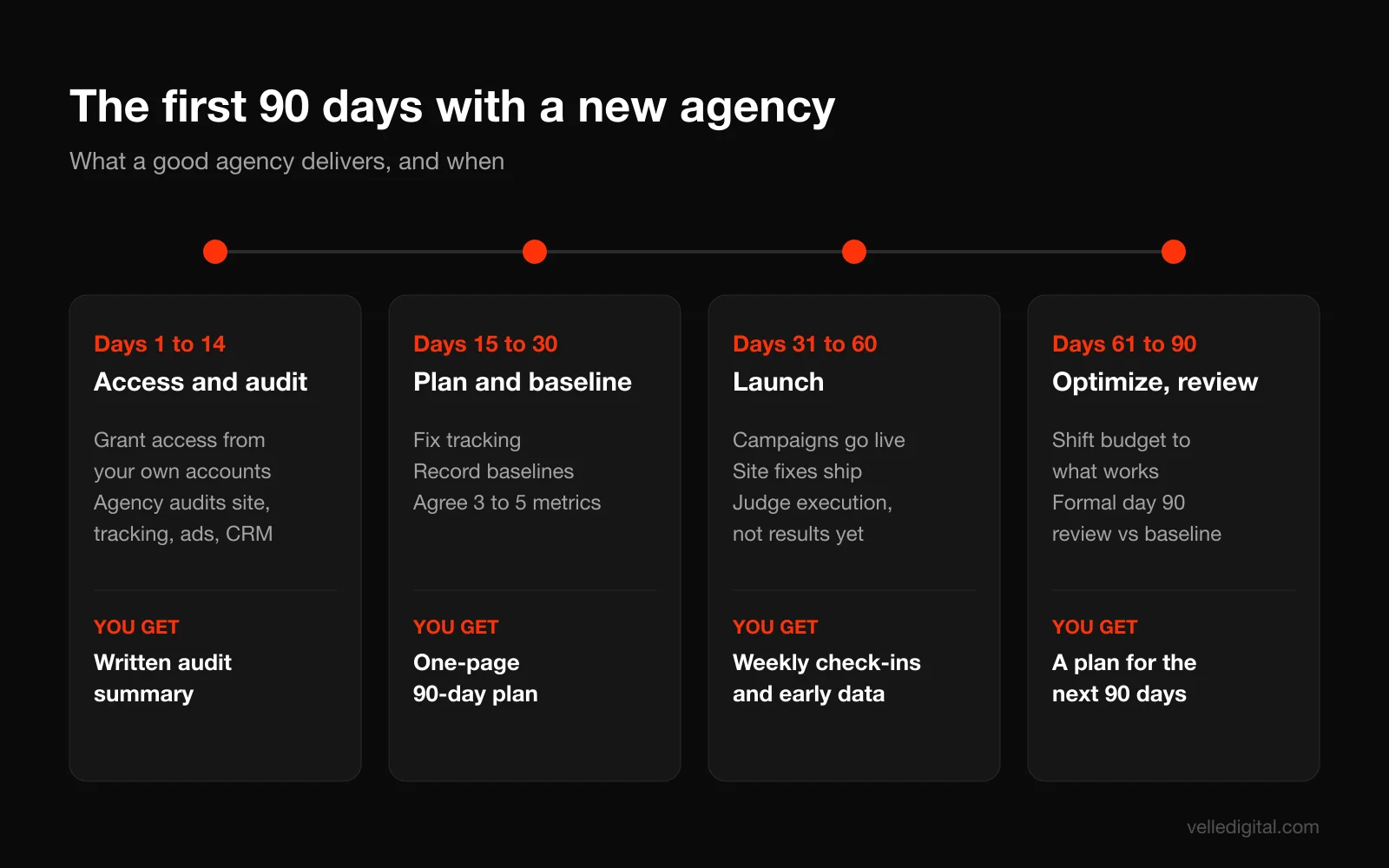
Days 1 to 14: access and audit
You grant access from your own accounts. The agency audits what exists: website, tracking, ad accounts, search visibility, reviews, CRM and how leads are handled.
Your job: supply access quickly, share past reports and answer questions within a day or two.
Deliverable to expect: a written audit summary that lists what is working, what is broken and what should be fixed first. If you want to see what a thorough review covers, our website audit checklist shows the website side.
Days 15 to 30: plan and baseline
The agency fixes tracking (so results can actually be measured), records baseline numbers and delivers a 90-day plan with priorities, owners and dates. Agree on the three to five metrics that will define success.
Deliverable: a one-page plan and a baseline report. If there is no measurement in place by day 30, everything after it is guesswork.
Days 31 to 60: launch
Campaigns go live, website fixes ship, content starts publishing. Early data comes in.
Do not judge results too early. Paid ads typically need a few weeks of data before optimization is meaningful, and SEO takes longer still (our local SEO guide explains why). But do judge execution: are deadlines met, is communication clear, are problems raised before you find them?
Days 61 to 90: optimize and review
The agency adjusts based on data: pausing what is not working, shifting budget to what is. At day 90, hold a formal review against the plan and baseline. Agree on what continues, what changes and what the next 90 days look like.
When to fire a marketing agency
Not every disappointing month means you hired the wrong agency. Marketing has variance. But some situations call for a change, and staying too long is expensive.
Signs it is time to go
- No clear plan after 60 days. Activity without direction.
- Reports you cannot understand, or that do not match reality. If their numbers and yours never reconcile, you cannot manage the relationship.
- Repeated missed deadlines with no explanation or improvement.
- You find problems before they do. Broken forms, paused campaigns, disapproved ads, a site that has been down for a day.
- They resist giving you access to your own accounts or data.
- No results after a fair test and no credible explanation or new plan. For paid ads, a fair test is usually a few months at an adequate budget. For SEO, longer.
- Your business has outgrown them, or changed direction in a way they cannot support.
Try one honest reset first
Before you fire an agency, have one direct conversation. Tell them what is not working, what you need to see and by when (30 days is reasonable). Put it in writing. Good agencies respond to clear feedback; sometimes the problem is a misunderstanding about goals or a client-side bottleneck you were not aware of. If nothing changes after the reset, you have your answer and a clean record of why.
How to leave cleanly
- Re-read the contract for notice period, fees and handover terms.
- Confirm you have admin access to every account before giving notice: domain, hosting, Google Ads, Meta, analytics, Business Profile, email platform and CRM.
- Give written notice and request the offboarding package: logins, files, creative, reports, documentation and any audiences or lists.
- Change passwords and remove agency access on the agreed end date, not before (they may need it to hand over cleanly).
- Download historical reports and data in case anything changes after they leave.
- Brief the next agency with the audit, the history and what did and did not work.
Common mistakes when choosing a marketing agency
- Hiring on price alone. The cheapest quote often leaves out the work that makes campaigns profitable: strategy, tracking and creative.
- Buying tactics before defining the goal. "We need TikTok" is not a strategy.
- Not budgeting for media. Fees with no ad spend or production budget produce nothing.
- Letting the agency own the accounts. The most expensive mistake on this list, usually discovered at the worst moment.
- Ignoring the sales process. If leads are not followed up quickly, no agency can fix your results. Many of the gaps we find are after the lead arrives, which is why we look at the whole path from ad to closed sale, as our guide to full funnel marketing explains.
- Changing agencies too often. Switching every three months means you are always in onboarding and never in optimization.
Checklist: how to choose a marketing agency
Use this checklist from first conversation to signed contract.
Before you talk to anyone
- Outcome written down: what, how much, by when, how measured.
- Rough numbers known: customer value, close rate, target cost per lead.
- Total budget set and split between fees and media.
- Internal owner named, with time to support the agency.
- One-page brief ready to send.
Shortlist and evaluation
- Three agencies whose typical client looks like you.
- Case studies reviewed for baseline, work, business result, timeframe and a named client.
- Live client work checked, not just the portfolio.
- Two current references and one former reference called.
Proposal and questions
- All 25 questions asked across calls and written responses.
- Answers scored 1 to 3, with ownership as pass or fail.
- Pricing model understood, including what it rewards.
- Everything included in the fee listed in writing.
- No red flags: account ownership, lock-in, guarantees, vanity reporting, secrecy, markups.
Contract
- You own the domain, accounts, website, content and data.
- IP assignment clause for all deliverables on payment.
- Reasonable initial term, then 30 days notice.
- Specific scope with exclusions.
- Reporting frequency and metrics defined.
- Offboarding and handover process written in.
- Compliance (consent, anti-spam, privacy) covered where relevant.
Frequently asked questions
How much does a marketing agency cost for a small business?
It depends on the scope, the channels and your market, which is why quotes vary so widely. Ongoing management is usually priced as a monthly retainer or a percentage of ad spend, while websites and branding are priced as projects. Always budget separately for ad spend and production, and compare quotes by what is included rather than the headline number.
Should I hire a marketing agency or a freelancer?
Hire a freelancer when the job is narrow, well defined and you can coordinate the pieces yourself. Hire an agency when you need several disciplines working together, more capacity or continuity when someone is away. Many businesses start with a freelancer for one channel and move to an agency as the work grows.
How long should I give a marketing agency to show results?
Judge execution (plans, deadlines, communication) from the first month, and judge results on a timeline that fits the channel. Paid ads usually show a clear direction within about 90 days, while SEO and brand work take longer. Agree on milestones in writing at the start so you are not guessing later.
What questions should I ask a marketing agency before hiring?
Ask who will work on your account, how they will measure success, what results they expect and on what timeline, who owns the accounts and creative, how they charge and what the contract term is. The 25 questions in this guide cover strategy, team, reporting, ownership and money, with what a good answer sounds like for each.
Is it a red flag if an agency guarantees results?
Usually, yes. Google states that no one can guarantee a number one ranking, and ad results depend on your market, offer and budget. A trustworthy agency commits to a process, transparent reporting and honest benchmarks, not to outcomes it cannot control.
Who should own my Google Ads and Facebook ad accounts?
You should. Create the accounts in your business name, billed to your card, and give the agency access through a manager account or as a partner. That way your data, audiences and history stay with you if you ever change agencies.
Ready to talk it through?
If you are weighing your options, we are happy to be one of your three, and just as happy to tell you if another kind of partner would fit better. You can see the full range of what we do on our services page, or book a free strategy call and bring this list of questions with you. We will answer every one.