How to Build a Brand Strategy: A Practical Small Business Guide
A brand strategy is not a logo. This step-by-step framework walks you through research, positioning, promise, voice and messaging, plus a workshop agenda your team can run in a day.
A brand strategy is a short set of decisions about who you serve, what you want to be known for, why anyone should believe you, and how you will sound and look everywhere a customer meets you. It is written down, it fits on a few pages, and it guides every later choice: your logo, your website copy, your ads, how your team answers the phone. It is not a logo, a color palette or a tagline. Those are outputs of the strategy, and they only work when the strategy underneath them is clear.
This guide walks you through building one yourself in nine steps: research, audience and jobs to be done, a positioning statement, a brand promise with proof points, personality and voice, a messaging hierarchy, briefs for naming and visual identity, rollout across touchpoints, and measurement. At the end there is a workshop agenda your team can run in a single day, a list of common mistakes, and a checklist. We build brand strategies for small businesses every month, and this is the process we use, minus the invoice.
What brand strategy is (and what it is not)
Your brand is what people say about you when you are not in the room. Brand strategy is the plan for shaping that on purpose instead of by accident.
Nielsen Norman Group describes brand in the digital age as the holistic sum of customers' experiences, made up of visual, tonal and behavioral components. That framing is useful for small businesses because it puts the logo in its proper place: one of three components, and arguably the least important of them. A plumber with a beautiful logo who shows up late and leaves a mess has a brand. It is just not the one on the truck.
A useful brand strategy answers six questions in plain language:
- Who exactly are we for, and who are we not for?
- What job are those customers hiring us to do?
- What do we want to be the obvious choice for, compared with the alternatives?
- What do we promise, and what proof do we have?
- How do we sound and behave?
- What do we say first, second and third?
If your whole team can answer those six questions the same way without notes, you have a brand strategy. If the answers are "quality," "service" and "trusted," you have a wish list.
Brand strategy vs. brand identity vs. marketing strategy
These three get mixed up constantly, and the confusion costs money because people hire for the wrong one.
- Brand strategy is the thinking: audience, positioning, promise, personality, messaging. It changes rarely, maybe every five to ten years, or when the business changes shape.
- Brand identity is the expression: name, logo, colors, typography, photography style, voice in practice. It is built from the strategy. We cover why it matters in our post on why brand identity matters for growing businesses.
- Marketing strategy is the distribution plan: which channels, what budget, which campaigns this quarter. It changes often, and it borrows its message from the brand strategy.
The order matters. If you design a logo before deciding who you are for, you are guessing. If you run ads before deciding what you stand for, every campaign reinvents the message, and none of them compound.
Signs you need a brand strategy now
Not every business needs a formal strategy on day one. A new solo operator is better served by getting customers and learning from them. But these signals tell you it is time:
- Your team describes the business differently depending on who you ask.
- You compete mostly on price, and you are tired of it.
- You are about to spend real money on a rebrand, a new website or a paid ads program.
- You have added services or moved upmarket and your current reputation is holding you back.
- Prospects regularly ask "so what makes you different?" and the honest answer is a shrug.
The brand strategy framework at a glance
Here is the full process on one page. Steps 1 to 3 are research and decisions about the customer. Steps 4 to 7 are the core strategy, written down. Steps 8 and 9 turn the strategy into something people can see and use.
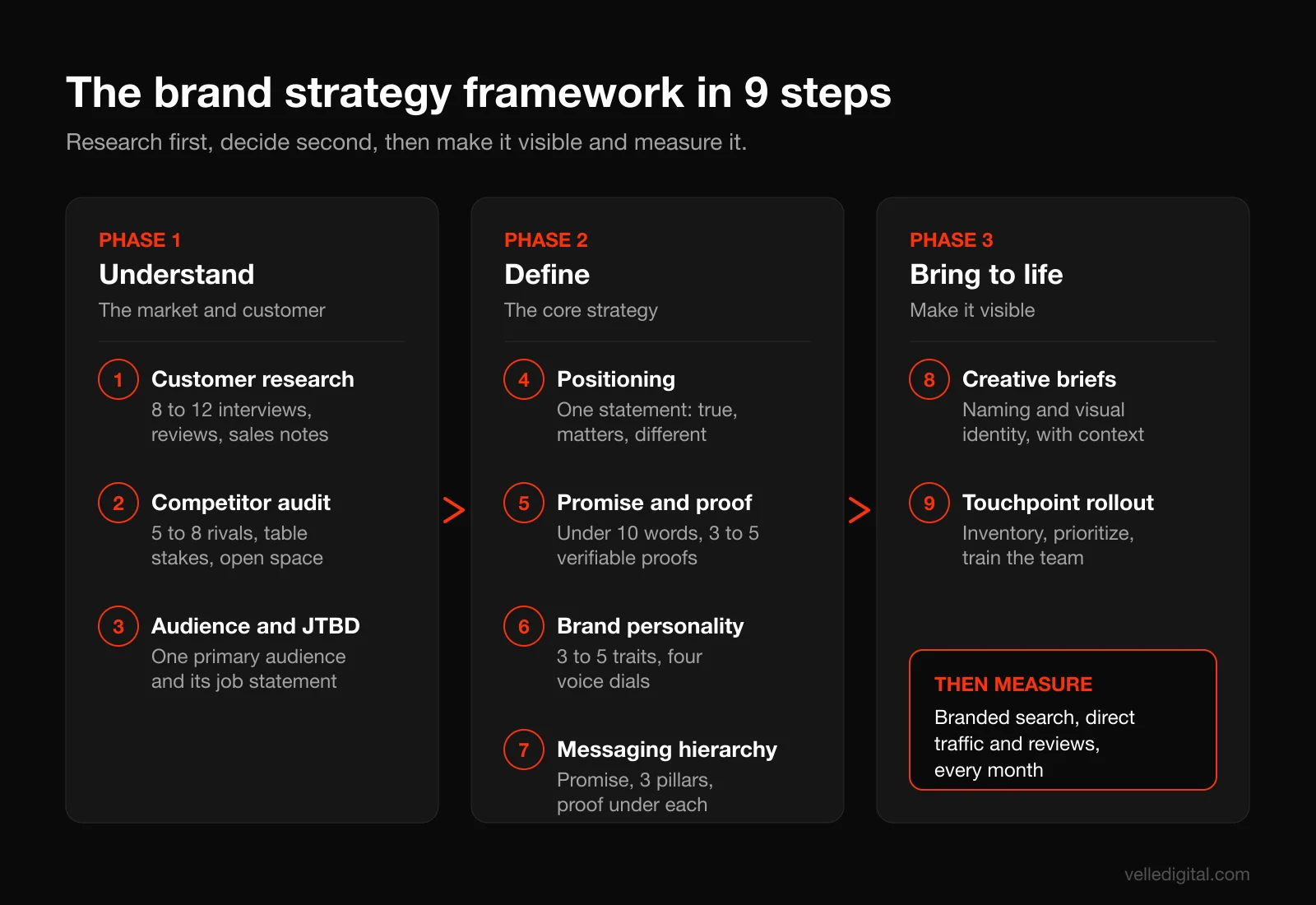
Plan on two to six weeks of elapsed time for a small business doing this in-house, most of it waiting on customer interviews. The writing itself can be done in a one-day workshop (agenda later in this guide) followed by a few hours of cleanup.
How to build a brand strategy in 9 steps
Throughout these steps we will use one hypothetical example so the templates feel concrete: Ridgeway Heating, an imaginary residential furnace and air conditioning company with eight technicians in a mid-sized Canadian city. Every number attached to Ridgeway is invented for illustration.
Step 1: Research your customers
Every good brand strategy starts with what customers actually say, in their own words. Not what you think they value, and not what your competitors claim. The goal of this step is a page of real customer language you can steal from later.
Who to talk to. Interview 8 to 12 people, split roughly like this:
- 5 to 7 of your best recent customers (the ones you would clone if you could)
- 2 or 3 customers who bought once and did not come back
- 1 or 2 people who got a quote and chose someone else
Your best customers tell you what to amplify. The lost ones tell you what is broken or unclear. If you only interview fans, you will write a strategy that flatters you.
How to run the interview. Keep it to 20 or 30 minutes by phone or video. Ask about past behavior, not opinions about the future. Nielsen Norman Group makes the point bluntly in its guidance on interviewing users: what people say and what they do are different, so interviews work best for exploring experiences and motivations, not for predicting behavior. Ask what happened, not what they would do.
Copy these questions:
What was going on in your life or business when you started looking for help with this?
What else did you consider, including doing nothing or doing it yourself?
What almost stopped you from going ahead?
Why did you pick us over the others? What was the moment you decided?
How would you describe us to a friend who asked?
If we disappeared tomorrow, what would you do instead?
Record and transcribe the calls (with permission), then paste every phrase that describes a problem, fear, trigger or outcome into one document grouped by theme. Customer phrases like "I just wanted someone who would tell me straight if I needed a new furnace" are better raw material for messaging than anything a copywriter invents from scratch.
Mine what you already have. Read your last 50 online reviews, your competitors' 2 and 3 star reviews, sales call notes and quote request questions. If nine of your reviews mention that the technician explained the options clearly, that is a brand asset you have not claimed yet.
Decision rule: if the same theme comes up in at least a third of your interviews and reviews, treat it as a real pattern. If it shows up once, note it and move on.
Step 2: Map your competitors and your category
Customers never evaluate you in isolation. They compare you with other companies, with doing it themselves, and with doing nothing. This step maps that landscape so you can find space nobody owns.
List your real alternatives. Pull these from your interviews ("what else did you consider?") rather than from your own assumptions. For Ridgeway, the list might look like this:
- Two large regional HVAC companies with big ad budgets
- A handful of one-truck operators who compete on price
- The big-box store's installation service
- A handyman cousin, or just living with the old furnace another winter
Audit 5 to 8 of them. For each competitor, spend 20 minutes on their website, Google Business Profile, social accounts and reviews. Capture the same fields every time:
- Who they seem to target (homeowners, landlords, new builds, commercial)
- Their main claim (the headline on their homepage)
- Their proof (years in business, certifications, guarantees, review count and rating)
- Their price signals (financing, "affordable," premium language)
- Their tone (formal, friendly, salesy, technical)
- What their unhappy customers complain about
Read the category, not just the companies. Look at the words every competitor uses. In most local service categories you will find the same five claims everywhere: family owned, licensed and insured, quality workmanship, customer satisfaction, competitive pricing. Write those down as "table stakes." You need them, but they will never differentiate you, because everyone says them.
Plot a simple map. Draw two axes that matter to customers in your category, then place each competitor. Good axis pairs for service businesses include price (budget to premium) versus scope (specialist to generalist), or speed (fast and transactional to slow and consultative) versus relationship (one-off to long-term). Empty quadrants are not automatically opportunities (sometimes no customer wants that combination), but a space your interviews say customers want, and nobody claims clearly, is where your positioning should live.
Check search demand while you are here. Google Trends shows relative interest in a topic over time and by region. Google explains that Trends data is normalized and scaled on a range of 0 to 100 based on a topic's share of all searches, so it shows relative popularity, not absolute volume. That is still useful: you can see whether people in your region search "furnace repair" or "heating repair," and whether a category term is growing or shrinking before you build a brand around it.
Step 3: Define your target audience and the jobs to be done
"Homeowners aged 30 to 65" is a demographic, not a target audience. Demographics tell you who might buy. They do not tell you why, which is the part a brand strategy needs.
Pick a primary audience. Choose the one group that is most valuable and most winnable for you, based on your customer research and your margins. You can serve others, but your brand speaks to this group first. For Ridgeway: homeowners in established neighborhoods with furnaces 12 or more years old, who care more about making the right long-term decision than getting the cheapest quote.
Name who you are not for. This feels uncomfortable, but it is where positioning gets its edge. Ridgeway is not for people shopping for the lowest possible install price, or for builders who need 40 units installed by Friday. Saying that internally lets you stop bending your message to please everyone.
Write the job to be done. The jobs to be done idea, popularized by Clayton Christensen and colleagues in Harvard Business Review's Know Your Customers' "Jobs to Be Done", argues that customers do not simply buy products. They hire them to make progress in a particular circumstance. The job is the progress, not the product.
Use this template, filled in from your interview notes:
When [situation or trigger], I want to [motivation or progress], so I can [desired outcome], without [fear or anxiety].
For Ridgeway:
When my old furnace starts making noises in October, I want someone I trust to tell me honestly whether to repair or replace, so I can get through winter without a breakdown, without being upsold on something I do not need.
The trigger (October, strange noises) tells you when to advertise. The motivation (honest advice) tells you what to promise. The fear (being upsold) tells you which objection to defuse.
Capture the three layers of the job. Most jobs have three sides, and strong brands address all of them:
- Functional: the practical task (keep the house warm, fix it fast).
- Emotional: how the customer wants to feel (in control, not taken advantage of).
- Social: how they want to be seen (a responsible homeowner, a smart decision maker).
Build a one-page audience profile. Skip the stock photo persona. Write a page with: the primary audience in one sentence, the job statement, top three triggers, top three anxieties, the alternatives they consider, the words they use (straight from transcripts), and where they look for information.
Step 4: Write your positioning statement
Positioning is the decision about what you want to own in your customer's mind, relative to the alternatives. The positioning statement is an internal tool, never a tagline. It is allowed to be clunky. It must be specific.
Use this template:
For [target audience] who [need or job to be done], [brand] is the [category or frame of reference] that [key benefit or point of difference], because [reason to believe].
Ridgeway's first draft:
For homeowners with aging furnaces who want honest advice before a big decision, Ridgeway Heating is the local heating and cooling company that tells you straight whether to repair or replace, because every technician is paid salary rather than commission and every quote shows both options side by side.
It works because each slot is concrete, the benefit is something a competitor could not claim without changing how they operate, and the reason to believe is a fact, not an adjective.
Test your statement against four questions:
- Is it true? Could you defend every word to a skeptical customer today, not after some future improvement?
- Does it matter? Did the benefit show up in your customer research as something people care about?
- Is it different? Could your top three competitors put their name in the same sentence without lying? If yes, rewrite.
- Is it focused? Does it say one thing? If you see "and" in the benefit slot, you have two positions, which means you have none.
Common positioning traps:
- Positioning on "quality" or "service." Every competitor claims both, so customers ignore them.
- Positioning on price when you are not structurally the cheapest. Someone can always go lower.
- Positioning on a feature anyone could copy next month, like a new booking tool.
Decision rule: if you have two strong candidate positions and cannot choose, pick the one your best customers mentioned unprompted in interviews. Unprompted praise is the most reliable signal you will get.
Step 5: Define your brand promise and proof points
The brand promise is the positioning turned into a commitment customers can feel. It is shorter than the positioning statement, written in customer language, and it should be something you can keep on your worst day, not just your best.
For Ridgeway:
Straight answers, both options, no pressure.
It might never appear word for word in an ad. It is the standard every touchpoint gets measured against.
Back every promise with proof points. A promise without proof is a slogan. Aim for three to five proof points, each one specific and checkable. Good proof falls into a few categories:
- Operational facts: salaried technicians, side-by-side quotes, a written repair-or-replace checklist left at every visit.
- Guarantees: a clearly worded workmanship warranty, or a policy that a second opinion visit is free if a repair is recommended.
- Third-party signals: certifications, manufacturer partnerships, review rating and volume.
- Customer evidence: specific testimonials that echo the promise in their own words.
Keep your claims honest and provable. In Canada, the Competition Bureau states that under the Competition Act it is against the law to advertise or market something in a way that is false or misleading, and courts look at the general impression a claim creates, not just its literal words. The US has similar truth-in-advertising rules. The practical rule for your proof points: if you cannot show the receipt, do not make the claim. "Best in the city" is a risk and a cliché. "4.8 stars from 312 Google reviews" (if true, and kept current) is proof.
Be careful with review-based proof. Reviews are some of the strongest proof a local business has, but the way you collect them matters. Google states plainly that offering incentives in exchange for reviews is prohibited and treated as fake and misleading content. Ask every customer, make it easy, and never pay for it. Our guide on how to get more Google reviews has a full request system you can copy.
Map proof to anxieties. Pair each anxiety from Step 3 with a proof point. A fear with no matching proof is a gap in your messaging or your operations.
Step 6: Define your brand personality and voice
Personality is how your brand behaves. Voice is how it sounds in writing and speech. Together they are what make two companies with similar services feel completely different.
Choose three to five personality traits. Use plain adjectives, and give each one guardrails so it cannot be misread. A trait list without guardrails is how "friendly" turns into "unprofessional" and "confident" turns into "arrogant."
For each trait, write it in this format:
- Trait: what it means for us, and what it does not mean.
Ridgeway's version:
- Straightforward: we say what we think and explain why. We are not blunt to the point of being dismissive.
- Patient: we take time to explain options. We do not lecture or drown people in jargon.
- Steady: calm, reliable, unflappable in an emergency. Not dull or robotic.
- Neighborly: warm and local. Not folksy or cute.
Set your voice on four dials. Nielsen Norman Group's research identifies four dimensions of tone of voice: formal vs. casual, serious vs. funny, respectful vs. irreverent, and enthusiastic vs. matter-of-fact. Place your brand on each one using a 1 to 5 scale. Ridgeway might land at 3 on formality (plain but not slangy), 2 on humor (light touches, never at the customer's expense), 1 on irreverence (always respectful), and 2 on enthusiasm (calm, not hyped).
Separate voice from tone. Your voice stays constant. Your tone flexes with the situation. A furnace emergency at 11 p.m. calls for a more serious, faster tone than a spring maintenance reminder, even though both come from the same voice. Write two or three examples of the same message in different situations so your team sees the range.
Write a "we say / we don't say" list. This is the most used page in any voice guide we have ever made. Ten to fifteen pairs is plenty:
- We say "Here are your two options." We don't say "You need a new unit."
- We say "We'll be there between 1 and 3." We don't say "We'll be there this afternoon."
- We say "That part is worn, here's a photo." We don't say "Trust us, it's shot."
If you are building out a full guide for your team, our post on creating brand guidelines your team will actually use covers how to document voice alongside logo, color and type rules.
Step 7: Build your messaging hierarchy
A messaging hierarchy decides what you say first, what you say next, and what supports it. Without one, every page, ad and sales call picks its own lead message. With one, a new hire can write a decent ad on day one.
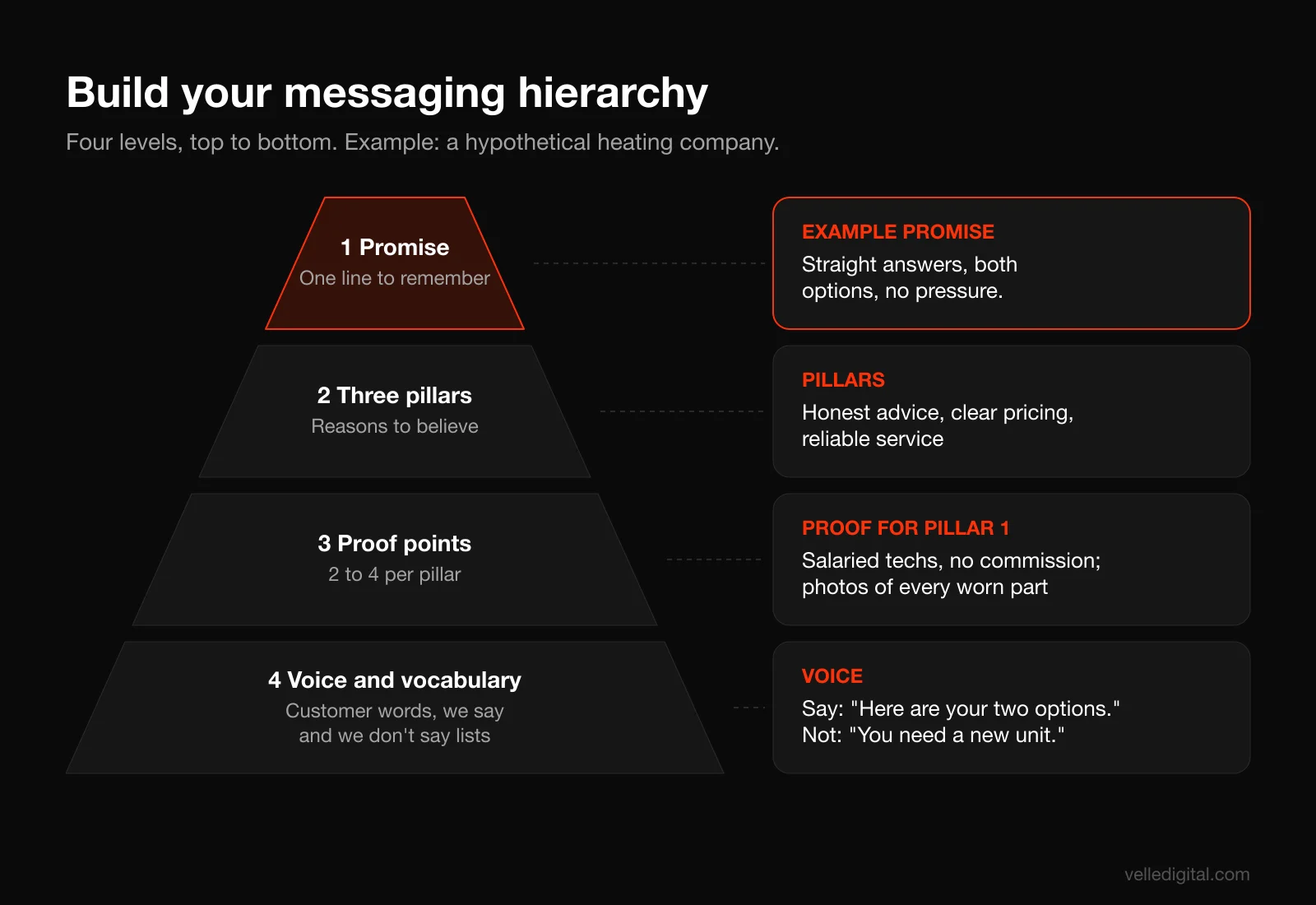
Build it in four levels:
- Brand promise (one line). The single idea you want remembered. From Step 5.
- Message pillars (three). The main reasons to believe the promise, each tied to a customer need from your research. Three is the right number for most small businesses: fewer feels thin, more gets forgotten.
- Proof points (two to four per pillar). The specific facts, guarantees, examples and testimonials that make each pillar believable.
- Voice and vocabulary. The words and phrases from your customer research, plus your "we say / we don't say" list.
Ridgeway's hierarchy, filled in:
- Promise: Straight answers, both options, no pressure.
- Pillar 1, Honest advice: salaried technicians with no commission; a written repair-or-replace checklist at every visit; photos of every worn part.
- Pillar 2, Clear pricing: side-by-side quotes for repair and replacement; flat diagnostic fee credited to the job; financing explained in plain terms.
- Pillar 3, Reliable service: two-hour arrival windows; text updates when the technician leaves; workmanship warranty in writing.
Write your core messages at three lengths. Your team needs the message at different sizes for different spaces. Write each of these once, and reuse them everywhere:
- Tagline or one-liner (under 10 words): "Honest heating advice. Both options, every time."
- Elevator pitch (about 25 words): "We're a local heating company that shows you repair and replace options side by side, with salaried techs who have no reason to upsell you."
- Boilerplate paragraph (60 to 90 words): the version for your About page, Google Business Profile description, press mentions and directory listings.
Map messages to the customer journey. Not every message belongs everywhere. Early in the journey (a social post, a search ad) lead with the promise and the job. In the middle (a service page, a comparison) bring in pillars and proof. Near the decision (a quote, a follow-up email) lead with guarantees and specifics that defuse the last anxieties. For writing the actual pages, our website copywriting guide shows how to turn a hierarchy into headlines, sections and calls to action.
Step 8: Write naming and visual identity briefs
Now you are ready to brief the creative work. The briefs translate strategy into constraints a designer or naming writer can work against.
When you need a naming brief. Most existing businesses should keep their name. Renaming is expensive and throws away whatever recognition you have built. Consider it only if the name is legally risky, actively misleading (you started as "Smith Furnace Repair" and now do full HVAC and plumbing across three cities), embarrassing, or impossible to find online. If none of those apply, invest in the strategy and identity and keep the name.
If you do need a name, the brief should cover:
- The positioning statement and brand promise
- Personality traits and the voice dials
- Name style preferences: descriptive (says what you do), suggestive (hints at a benefit), or abstract (a coined word that needs marketing to give it meaning)
- Must-haves: easy to say aloud, easy to spell after hearing it once, works in your service area languages, short enough for a truck door
- Availability checks: trademark, domain, social handles, and business registration in your province or state
Check trademarks before you fall in love. Run every shortlisted name through the Canadian Trademarks Database and, if you sell into the US, the USPTO trademark search. A clean search is not legal clearance, so for a final name that you will build a business on, pay a trademark lawyer for an opinion. It costs far less than a forced rename later.
The visual identity brief. Whether you hire a designer or an agency like our brand identity team, give them a brief with these sections:
- Background: what the business does, who it serves, and why you are doing identity work now.
- Strategy summary: positioning statement, promise, three pillars, personality traits with guardrails.
- Audience: the one-page profile from Step 3.
- Competitive context: screenshots of the 5 to 8 competitors you audited, with a note on what everyone in the category looks like. If every HVAC company uses red and blue with a flame icon, say so, and say whether you want to stand apart or fit in.
- Where it will live: list every application in order of importance (truck wraps, website, Google Business Profile, uniforms, invoices, yard signs, social avatars). A logo that has to work on a 40 pixel social avatar and a 20 foot truck has different constraints than one for a printed menu.
- Assets to keep: any colors, symbols or names with recognition worth protecting.
- What success looks like: three or four sentences, for example "A homeowner seeing our truck in the neighborhood should read calm, competent and local, not cheap and not corporate."
- Mandatories and practical limits: budget, deadline, number of concepts, file formats you need, accessibility requirements such as color contrast for text.
Judge creative against the brief, not taste. Score each concept against the personality traits and the success statement before anyone says "I like the blue one."
Step 9: Roll it out across every touchpoint
A strategy that lives in a slide deck changes nothing. Rollout is where most small businesses stall, because it is dozens of small, unglamorous updates.
Start with a touchpoint inventory. List every place a customer or prospect encounters your business. For a typical local service company, that list includes:
- Website, including service pages, contact forms and confirmation emails
- Google Business Profile, Apple Maps, Bing Places and directory listings
- Social media profiles and bios
- Vehicles, uniforms, signage and yard signs
- Quotes, invoices, contracts and email signatures
- Phone greeting, voicemail and the script your office uses to answer
- Automated emails and text messages from your CRM or booking software
- Job site behavior: arrival, boot covers, cleanup, the walkthrough before leaving
Remember the NN/g framing: brand is visual, tonal and behavioral. That last section of the list (how a technician behaves in someone's home) often does more for your brand than your logo ever will.
Prioritize by impact and effort. Score each touchpoint on two things: how many prospects see it, and how hard it is to change. Fix the high-visibility, low-effort items in the first two weeks: website homepage and about page, Google Business Profile description, social bios, email signatures, phone greeting. Plan the expensive items (vehicle wraps, signage, a full website rebuild) on a 3 to 12 month schedule, often replacing them as they wear out rather than all at once.
Update your Google Business Profile early. For local businesses it is often the first brand impression, before your website. Google notes that prominence, meaning how well-known a business is, is one factor in local ranking, informed by things like links and review count. Rewrite your business description using your boilerplate paragraph, refresh photos to match your new visual direction, and start replying to reviews in your brand voice. Our local SEO guide covers the rest of the profile.
Launch internally before externally. Your team needs to understand and believe the strategy before customers see it. Run a 60 to 90 minute session that covers the why (what you learned in research), the promise, the three pillars, the personality, and the "we say / we don't say" list. Then have each person practice: the office manager rewrites the phone greeting, a technician explains a repair-or-replace decision in the new voice, the owner rewrites one service page. People own what they help build.
Give people tools, not just rules. A quote template that already shows both options side by side enforces the promise better than any memo. Add a review reply bank and social post templates.
Decision rule: if a touchpoint contradicts the promise (a commission-based sales bonus at a company promising no pressure, for example), fix the operation before you fix the marketing. Advertising a promise your operations break is the fastest way to burn a brand.
How to measure your brand strategy
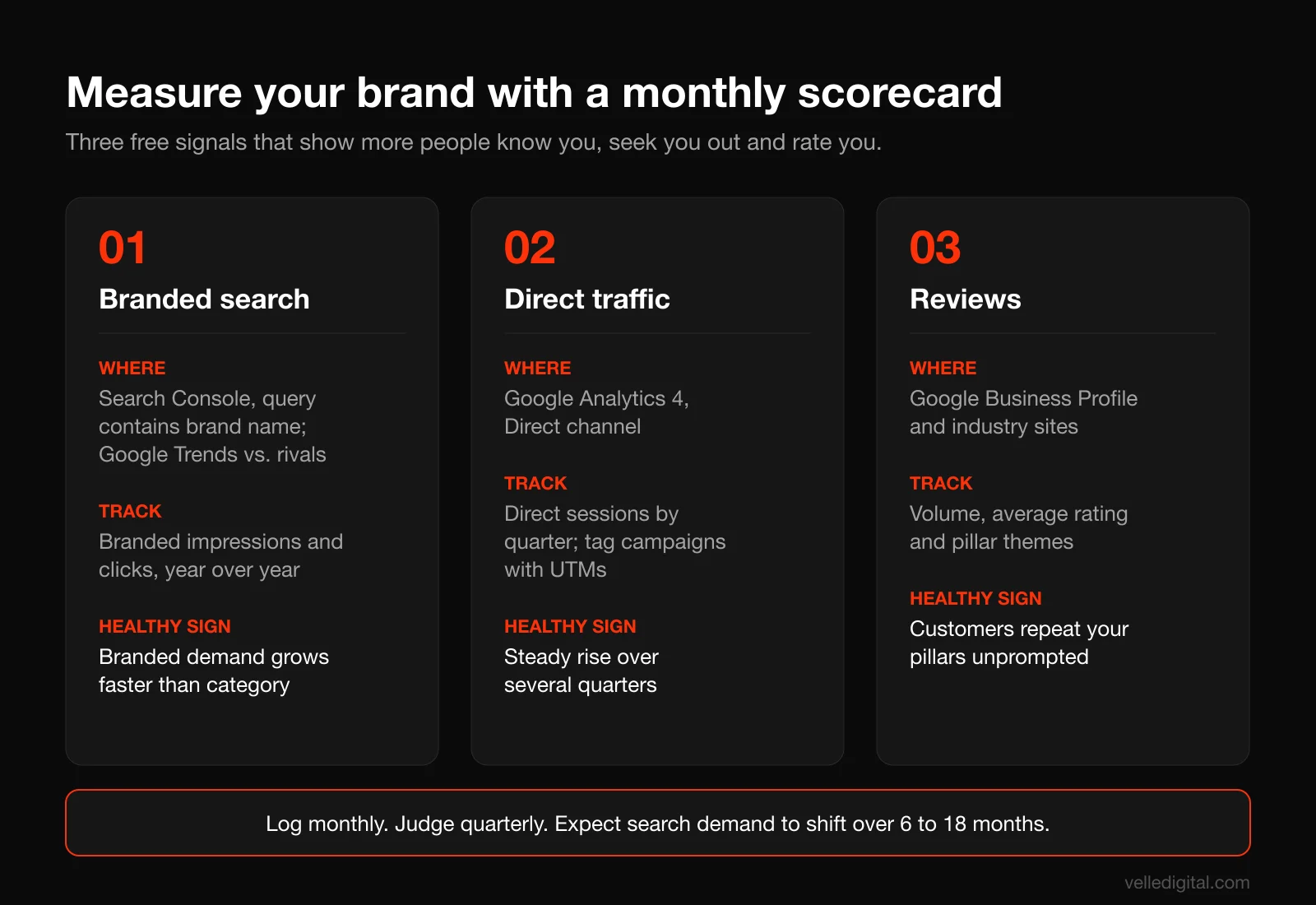
Brand is harder to measure than a click, but it is not invisible. You are looking for evidence that more people know you, seek you out by name, and say good things when they do. Track a small scorecard monthly and review it quarterly.
Branded search demand
When a brand gets stronger, more people search for it by name. That is the single cleanest brand signal most small businesses can access for free.
- Open the Search Console Performance report, which shows the queries that bring people to your site from Google Search.
- Add a query filter that contains your brand name (and common misspellings).
- Record branded impressions and clicks for the month. Compare month over month and, more importantly, year over year, since many businesses are seasonal.
- Separately, compare your brand name against two or three competitors in Google Trends for your region. Remember it is a relative index, so you are watching the trend lines, not reading off volumes.
For a hypothetical Ridgeway, a healthy sign would be branded impressions rising year over year while category demand stays flat.
Direct traffic
Direct visits are people who type your URL or use a saved link. In Google Analytics 4's default channel definitions, Direct is the channel by which users arrive via a saved link or by entering your URL. Rising direct traffic often means people remember you.
Treat it with care, though. Direct also catches traffic that analytics could not attribute (some apps, some email clients, untagged links), so it is noisy. Watch the trend over quarters, not the number in any single week, and make sure your own campaigns use UTM tags so they do not inflate it.
Reviews and what they say
Reviews measure the behavioral side of your brand, which is the part your logo cannot fake. Track three things monthly:
- Volume: new reviews per month across Google and any platforms that matter in your industry.
- Rating: your average, and the share of 4 and 5 star reviews.
- Themes: read every review and tally which pillar it mentions. If your pillars are honest advice, clear pricing and reliable service, you want to see those words, or close cousins, showing up unprompted.
The theme count is the most underrated brand metric we know. When customers start describing you in the language of your own strategy, without being asked, the brand is landing.
Other signals worth tracking
- Close rate on quotes. A clearer brand usually means fewer price objections. Track the share of quotes that close, by service type.
- How did you hear about us? Add the question to your intake form. Watch "referral" and "saw your truck" or "searched your name" grow.
- Brand lift studies. If you run YouTube or Demand Gen campaigns at meaningful scale, Google's Brand Lift uses surveys to measure effects such as ad recall, awareness and consideration. Most small businesses will not need this, but it is the most rigorous option available without a research firm.
Set realistic expectations. Brand metrics move slowly. Expect early signals (review themes, close rate, team consistency) in the first 90 days and search demand changes over 6 to 18 months, depending on how much you are spending to put the brand in front of people.
A one-day brand strategy workshop agenda
If you want to compress the writing part of this process, run a workshop. Do the customer interviews and competitor audit beforehand, then use one day to make the decisions together. This is roughly the agenda we use with small business teams.
Who should attend: the owner or owners, whoever leads sales, whoever leads operations or field service, and one front-line person who talks to customers every day (an office manager, a senior technician). Four to seven people is ideal. More than eight and the day turns into a debate club.
Prep (one week before): share the interview highlights document, the competitor audit and the touchpoint inventory. Ask everyone to read them and bring three words they think customers would use to describe the business today, and three words they wish customers would use.
The agenda:
- 9:00 to 9:30, Ground rules and goals. Explain what you will leave with: a draft positioning statement, promise, pillars, personality and a rollout list. Agree that the owner makes final calls when the group is split.
- 9:30 to 10:30, Customer playback. Read the most striking interview quotes aloud. As a group, cluster them into triggers, anxieties and outcomes on sticky notes or a shared board.
- 10:30 to 11:15, Competitor and category review. Walk through the audit. List the table stakes claims everyone makes. Plot competitors on two axes and circle the space your customers want that nobody owns.
- 11:15 to 12:00, Audience and job to be done. Agree on the primary audience and who you are not for. Each person writes a job statement using the template, then merge them into one.
- 12:00 to 12:45, Lunch. Do not skip this. Decisions after 2 p.m. get worse without it.
- 12:45 to 1:45, Positioning. Everyone drafts a positioning statement alone for 10 minutes. Read them aloud, vote on the strongest parts, then combine into one. Run it through the four tests: true, matters, different, focused.
- 1:45 to 2:30, Promise and proof. Write the brand promise in under 10 words. List every proof point you can verify today, then match them to customer anxieties. Flag gaps.
- 2:30 to 2:45, Break.
- 2:45 to 3:30, Personality and voice. Pick three to five traits with guardrails. Set the four voice dials. Write at least eight "we say / we don't say" pairs using real situations from your business.
- 3:30 to 4:15, Messaging hierarchy. Choose three pillars and assign proof points to each. Draft the one-liner and elevator pitch together.
- 4:15 to 4:45, Rollout plan. Go through the touchpoint inventory. Mark each item as fix this month, fix this quarter or fix when replaced. Assign an owner to each.
- 4:45 to 5:00, Wrap-up. Read the full draft aloud. Name who will clean it up, and set a date (within a week) to review the written version.
Facilitation tips:
- Have someone outside the leadership team facilitate if you can. Owners tend to dominate their own workshops without meaning to.
- Write alone first, then discuss. It prevents the loudest voice from setting the anchor.
- Capture exact wording in a shared document as you go. Do not trust anyone to remember phrasing at 5 p.m.
After the workshop: one person turns the outputs into a strategy document of 4 to 8 pages. Circulate it, collect comments for three days, and hold a 45 minute review to finalize. Then test the positioning and promise informally with three or four of your best customers. If they say "yes, that's exactly why I picked you," you are done. If they look puzzled, revisit the positioning.
Common brand strategy mistakes
Most of these come from skipping steps or treating strategy as a creative exercise instead of a business one.
- Starting with the logo. A new logo on an unclear business is a more expensive version of the same confusion. Strategy first, identity second.
- Skipping customer research. Owners know their business deeply, but they rarely know how customers describe it. Ten interviews will surprise you.
- Trying to appeal to everyone. A brand for everyone is a brand for no one. Picking a primary audience does not stop others from buying.
- Using words that mean nothing. "Quality," "integrity," "solutions" and "passion" are not positions. If a competitor could use the sentence unchanged, it is not your strategy.
- Promising what operations cannot deliver. If you promise two-hour arrival windows and routinely miss them, the brand gets worse, not better. Fix the operation first.
- Changing direction every quarter. Brands compound through consistency. Most owners get bored of their messaging long before customers have even noticed it.
- Writing it and filing it. If the strategy is not in your templates, training and review replies, it does not exist.
Brand strategy checklist
Use this before you brief any creative work or spend money on a rebrand.
- Interviewed 8 to 12 customers, including at least two lost or one-time customers
- Read your last 50 reviews and your top competitors' reviews
- Audited 5 to 8 competitors using the same fields for each
- Listed the table stakes claims in your category
- Chosen one primary audience and written who you are not for
- Written a job to be done statement with trigger, motivation, outcome and fear
- Written a positioning statement that passes the true, matters, different and focused tests
- Written a brand promise in under 10 words
- Listed three to five verifiable proof points and matched them to customer anxieties
- Defined three to five personality traits, each with a guardrail
- Set your voice on the four dials and written at least ten "we say / we don't say" pairs
- Built a messaging hierarchy with one promise, three pillars and proof under each
- Decided whether to keep your name, and checked trademarks for any new one
- Written a visual identity brief with competitive context and a list of applications
- Built a touchpoint inventory with priorities and owners
- Run an internal launch session with your team
- Set up a monthly scorecard: branded search, direct traffic, reviews and review themes
- Scheduled an annual strategy review
Frequently asked questions
What is a brand strategy in simple terms?
A brand strategy is a written plan for how you want customers to think and feel about your business, and how you will earn that reputation. It defines your audience, your positioning, your promise and proof, your personality and your key messages. Everything else, from your logo to your ad copy, is built on top of it.
What are the key elements of a brand strategy?
The core elements are a target audience with a clear job to be done, a positioning statement, a brand promise backed by proof points, brand personality and voice, and a messaging hierarchy. Most strategies also include briefs for naming and visual identity, and a rollout and measurement plan. Purpose, mission and values statements are useful additions, but only if they actually guide decisions.
How long does it take to build a brand strategy?
For a small business doing it in-house, expect two to six weeks from first customer interview to finished document. Most of that time is scheduling interviews and gathering competitor information. The decisions themselves can be made in a focused one-day workshop, followed by a few hours of writing and a review meeting.
Is a logo part of brand strategy?
No. A logo is part of brand identity, which is the visual and verbal expression of the strategy. The strategy should come first and should be the brief for the logo. Designing a logo without a strategy is guessing, and it usually leads to a second redesign within a few years.
How much does a brand strategy cost?
Doing it yourself costs mainly time, roughly a few days spread across several weeks, plus small costs like interview incentives or transcription software. Hiring a freelancer or agency ranges widely depending on how much research and how many deliverables are included, and is often bundled with identity design. Whatever the budget, make sure customer research is in the scope, because a strategy built only on internal opinion rarely holds up.
How do you know if a brand strategy is working?
Look for more people searching your brand name, rising direct traffic over time, more reviews that mention the things your strategy emphasizes, higher quote close rates and less price resistance. Early signals like team consistency and review themes show up within a few months. Search demand and reputation changes take longer, often 6 to 18 months.
What is the difference between brand strategy and marketing strategy?
Brand strategy defines who you are, who you serve and what you stand for, and it changes rarely. Marketing strategy decides how you reach people: channels, budgets, campaigns and timing, and it changes often. Good marketing borrows its message from the brand strategy, so every campaign reinforces the same reputation instead of starting over.
Should a small business do brand strategy before a new website?
Yes, if you can. A website built on a clear strategy has sharper headlines, clearer service pages and better conversion because every section knows what it is trying to prove. At minimum, write the positioning statement, promise and three pillars before your web designer starts on page layouts.
A clear brand strategy makes every later decision faster and every marketing dollar work harder, and you can build most of it with the steps above and a day with your team. If you would rather have experienced help running the research, positioning and identity work, our brand strategy and identity services take you from customer interviews to a finished visual system, and our brand guidelines service turns it into a guide your team will actually use. When you are ready, book a call with our team and we will talk through where your brand stands today.