Content Marketing Strategy for Small Business: A 12 Step Plan
A step-by-step content marketing strategy for small businesses: real buyer questions, topic clusters, a pace you can sustain, repurposing one piece into ten, measuring ROI and a 90 day plan.
A content marketing strategy is a written plan for which questions your business will answer, for whom, in what formats, how often, where each piece will be distributed, and how you will know whether it produced customers. For a small business, a good one fits on two pages, ties every piece of content to a stage of your sales pipeline, and is built around a publishing pace you can actually keep for a year.
The short version: pick one or two business goals, collect the real questions your buyers ask, group those questions into a few topic clusters, choose one core format you can sustain, publish on a fixed calendar, repurpose every core piece into smaller ones, distribute it deliberately, measure leads rather than traffic, and refresh what already works. This guide walks through each of those steps in order, with templates, worked numbers and the decision rules we use with clients, ending with a 90 day plan you can start on Monday.
What a content marketing strategy is (and what it is not)
Most small businesses that say they "do content" actually have a habit, not a strategy. Someone posts when they have time, writes a blog article when a slow week comes around, and wonders why none of it shows up in sales.
A strategy answers six questions in writing:
- Why: which business outcome is this content supposed to move?
- Who: which specific buyer are you writing for, and what do they already know?
- What: which questions and topics will you own?
- How: which formats, at what length, at what pace?
- Where: how will each piece reach people after you hit publish?
- So what: how will you measure whether it worked, and what will you change?
What it is not: a list of blog titles, a social media posting schedule, or a decision to "start a podcast." Those are outputs. If you cannot say which buyer question a piece answers and what you want that reader to do next, it does not belong on the calendar yet.
Content marketing also sits inside your wider marketing system. It feeds search, email, social and sales conversations, and it gets fed by them. If you have not mapped how a stranger becomes a customer at your business, read our guide to building a full-funnel marketing strategy first. It will make every step below easier.
Why most small business content fails
Before the steps, it helps to know the failure patterns. In our experience they are the same across industries.
- It is written for the business, not the buyer. Company news and "5 reasons to choose us" posts answer questions nobody searched for.
- It is generic. Advice identical to 4,000 other pages, with no detail that proves a real expert wrote it.
- The pace is unsustainable. Three posts a week in January, nothing by March. A blog whose last post is two years old makes the business look closed.
- Nobody distributes it. It gets shared once on Facebook and sits there.
- Success is measured in traffic. A viral post brings 10,000 visitors who will never buy, while the "kitchen remodel cost in Edmonton" page that brings 200 local visits and four quote requests gets ignored.
- Nothing gets updated. The best performers are usually pages refreshed every year, not new ones.
Every step below is designed to prevent one or more of these.
What you need before you start
You do not need expensive software. You need:
- Access to your analytics. Google Analytics 4 and Google Search Console connected to your website. Search Console is free and the best source of content ideas you already own.
- Access to your sales conversations. Email inbox, call notes, CRM records, chat transcripts, reviews. This is where the real buyer language lives.
- One owner for the strategy. One person, not a committee, accountable for the calendar.
- A realistic time budget. Write down how many hours per week your business can genuinely put into content, including review time from whoever has the expertise. Be honest. Four hours a week sustained for a year beats 20 hours a week for six weeks.
How to build a content marketing strategy in 12 steps
The steps are in order for a reason. Goals decide audience, audience decides topics, topics decide formats, and formats decide what a sustainable calendar looks like. Skipping ahead to "what should we post" is how most plans end up as a list of random titles.
Step 1: Tie content goals to your pipeline
Start with the business, not the content. Write down the one or two outcomes that matter most over the next 12 months. For most small businesses it is one of these:
- More qualified leads or booked calls
- Higher close rate (prospects arrive better informed and more trusting)
- Bigger average job or order value
- Fewer low-fit inquiries wasting your team's time
- More repeat and referral business
Now map content to the pipeline stages that outcome depends on:
- Discover: the buyer has a problem and is searching. Content: how-to guides, explainers, cost breakdowns, comparisons.
- Decide: the buyer is choosing who to hire. Content: case stories, process pages, pricing, "what to expect" guides.
- Buy and stay: the buyer has signed. Content: onboarding guides, care instructions, checklists that earn referrals.
Then set targets you can actually measure. Here is a template you can copy:
Goal: generate 15 qualified quote requests per month from organic content by month 12. Leading indicators: 40 pages indexed, 3 topic clusters complete, 1,500 organic sessions per month to content pages, 1.5% content-to-lead conversion rate.
Decision rule: if your sales team is turning away work or has a waitlist, your goal is not more leads. It is better leads and higher value jobs, so weight your calendar toward Decide content that qualifies and filters. If your pipeline is thin, weight toward Discover content that gets you found.
Step 2: Define your audience and research their real questions
You probably have a sense of who your customer is. Make it specific enough to write for. For each core buyer, fill in this short profile:
- Who they are (role, life stage, situation that triggered the search)
- What problem pushed them to look for help right now
- What they have already tried
- What they are afraid of (overpaying, getting ripped off, choosing wrong, wasting time)
- What words they use to describe the problem (not your industry jargon)
- Who else influences the decision (spouse, business partner, finance, landlord)
Keep it to one or two buyers. A renovation company might write for "homeowners aged 35 to 60 planning a kitchen remodel they will live with for 15 years" and "real estate investors updating a rental between tenants." Those two buyers ask completely different questions, care about different things, and need different content.
Now collect questions. This is the most valuable hour you will spend on your strategy. Open a spreadsheet and gather at least 50 real questions from these sources:
- Your inbox and call notes. Search prospect emails from the last year for question marks. Every question asked before buying is a topic.
- Your front line staff. Ask whoever answers the phone for the 10 questions they hear most, and what people misunderstand about your work.
- Sales objections. Every reason a prospect gave for delaying or choosing a competitor.
- Google Search Console. Open the Performance report, set the range to 12 months, and filter the Queries tab for "how," "cost," "vs," "best" and "near me."
- Google's results. Note the "People also ask" questions, related searches and autocomplete suggestions for your core services.
- Reviews. Yours and your competitors'. Praise shows what buyers value; complaints show what they fear.
- Communities. Local Facebook groups, Reddit and industry forums, where people ask what they would not ask a salesperson.
For each question, record the exact wording, the source, the buyer and the pipeline stage. Exact wording matters: "how much is a new roof" and "roof replacement cost per square foot" lead to different pages.
Step 3: Turn questions into keywords and topic clusters
Now group your questions. You will notice they bunch around a handful of themes. Those themes become your topic clusters.
A topic cluster has two parts:
- A pillar page: a comprehensive guide to the broad topic (for example, "Kitchen remodeling: the complete guide for homeowners").
- Cluster pages: focused articles that each answer one specific question in depth (for example, "How much does a kitchen remodel cost," "How long does a kitchen remodel take," "Quartz vs granite countertops," "Can you live at home during a kitchen remodel").
Every cluster page links up to the pillar, the pillar links down to every cluster page, and related cluster pages link to each other. The pillar links to your service page, which is where the buyer can act.
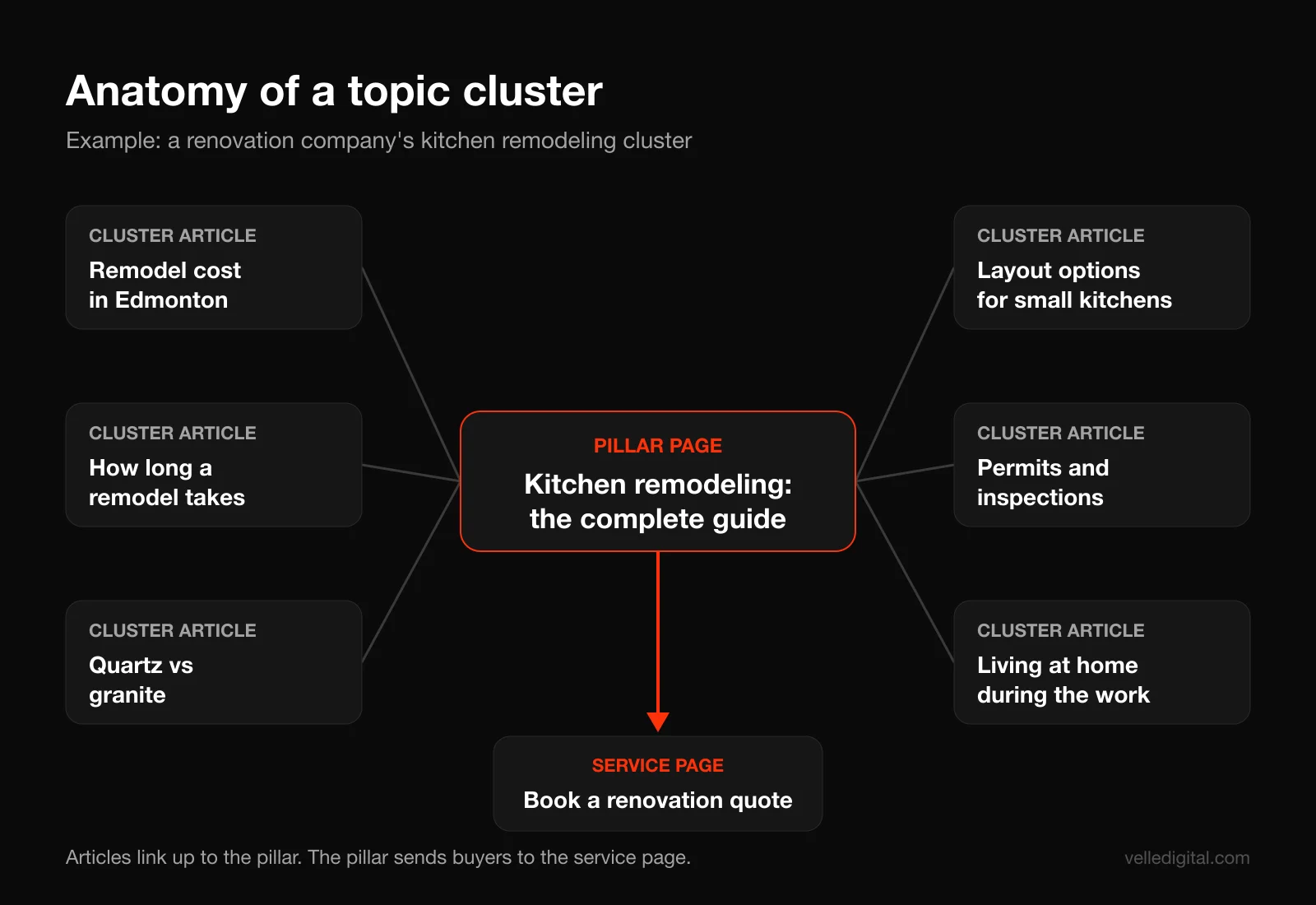
Why clusters work: they mirror how buyers research, they make your expertise obvious, and they give Google a clear picture of what your site covers. Google's SEO starter guide recommends linking related pages with descriptive anchor text so people and search engines understand what each page is about. Clusters are a disciplined way of doing that.
Here is how to build them:
- Group the questions. Sort your spreadsheet into three to five themes. Most small businesses should start with three clusters, tied to their highest margin services.
- Find the keyword for each question. Use autocomplete and related searches to see how people phrase it. If you run Google Ads, Keyword Planner gives rough volumes for free. You need the most common phrasing, not exact numbers.
- Check the search results. If the top results are how-to guides, write a guide. If they are product pages or local listings, that keyword belongs on a service page instead.
- Choose one primary keyword per page. Two pages targeting the same keyword compete with each other. If two questions have the same search results, they belong on the same page.
- Prioritize. Score each page 1 to 3 on business value (how close is the reader to buying?), 1 to 3 on ranking difficulty (can a small site realistically rank?), and 1 to 3 on your expertise (can you say something nobody else can?). Write the highest totals first.
Decision rules for small sites:
- If a keyword's first page is dominated by national publishers and huge brands, add a local or specific angle ("kitchen remodel cost in Edmonton," "kitchen remodel cost for a condo") or skip it.
- If a question gets asked constantly by your customers but shows little or no search volume, write it anyway. It will close sales even if it never ranks, and your team can send the link.
- If a question has high volume but buyers who ask it would never hire you, skip it, no matter how tempting the traffic.
For local businesses, include location-specific pages where costs, permits or rules genuinely vary by city. Our local SEO guide covers how those pages work alongside your Google Business Profile.
Step 4: Choose formats you can sustain
This is where most plans quietly fail. Owners pick formats based on what they admire (a weekly podcast, a YouTube channel, a daily newsletter) rather than what they can keep producing for 12 months with the people they have.
Pick one core format that becomes the source of everything else, and a small set of derivative formats you create from it. The core format should match your strengths:
- If you or someone on your team writes well: long-form articles and guides. Best for search, easiest to repurpose, easiest to update.
- If you explain things better out loud: recorded video or audio. Record a 15 to 25 minute explanation of one topic, then have it transcribed and edited into an article.
- If you are visual and your work is visual (renovation, landscaping, design, food): project walkthroughs with photos and short video, written up as case stories.
- If you sell to businesses: guides, checklists and templates people can use, plus webinars or recorded workshops.
Then set the pace using this rule: choose the frequency you could keep up during your busiest month of the year, not your quietest. For most small businesses that is one core piece every two weeks or two per month. A business that publishes two excellent, specific, well-distributed pieces a month for a year will beat one that publishes 12 thin pieces in January and nothing after.
Here is a realistic weekly time budget for one core article every two weeks:
- Topic research and outline: 1 hour
- Expert interview or recording (owner or technician): 30 to 45 minutes
- Writing and editing: 4 to 6 hours
- Photos, figures or examples: 1 hour
- Publishing, internal links and repurposing: 2 hours
- Distribution: 1 hour
That is roughly 10 hours every two weeks, or about five hours a week. If you do not have five hours, publish monthly. If you have the budget, outsource the writing and keep the expert interview in house, because expertise is the part nobody else can supply. Our content marketing service is built around exactly that split: your team supplies the knowledge in a short interview, and we handle the research, writing, figures and distribution.
Avoid choosing a format because a competitor uses it (podcasts are hard to discover and measure without an existing audience), and avoid any format only the owner can produce. If the owner gets busy, the content stops.
Step 5: Build your editorial calendar
Your editorial calendar turns the strategy into a schedule. Keep it simple: a shared spreadsheet or a board in whatever project tool your team already uses. Do not buy software for this.
Each row is one piece of content, with these columns: publish date, working title, primary keyword, cluster, pipeline stage, buyer, the core question it answers, expert source, call to action, status (idea, outlined, drafted, in review, scheduled, published), owner, repurposing done, distribution done, and the final URL.
Planning rules that keep it realistic:
- Plan one quarter at a time. Fill the next 12 weeks with specific topics. Keep a backlog of ideas beyond that, but do not schedule them yet.
- Balance the stages. A good starting mix for a business that needs leads is about 60% Discover, 30% Decide and 10% Buy and stay. Adjust based on Step 1.
- Build clusters in order. Publish the pillar and the two or three highest priority cluster pages for one topic before starting the next cluster. Half-built clusters across five topics help nobody.
- Work two pieces ahead. If you publish every two weeks, the next two pieces should always be drafted. That buffer is what keeps you on schedule during busy weeks.
- Pin seasonal topics early. If you sell air conditioning, publish summer content in early spring. Search interest builds before the season, and new pages take time to rank.
- Leave one slot a month for refreshes. Step 11 explains why.
A sample quarter for a renovation company publishing twice a month might look like this:
- Week 1: Pillar: Kitchen remodeling guide for homeowners (Discover)
- Week 3: How much does a kitchen remodel cost in Edmonton (Discover, high intent)
- Week 5: How long does a kitchen remodel take, week by week (Discover)
- Week 7: What to expect when you hire us: our 6 stage remodel process (Decide)
- Week 9: Quartz vs granite vs laminate countertops (Discover)
- Week 11: Case story: a 1970s galley kitchen opened into a family kitchen (Decide)
Notice that every title is a question a real buyer asks, and that the quarter finishes one cluster rather than dabbling in several.
Step 6: Write for people first, the way Google asks
Google's guidance on creating helpful, reliable, people-first content is the closest thing you will get to an official brief for content that ranks. Three points matter most for small businesses.
First, Google says plainly that it does not have a preferred word count. Its self-assessment questions ask whether you are "writing to a particular word count because you've heard or read that Google has a preferred word count," and the answer given is "No, we don't." Length should come from answering the question completely, not from padding.
Second, the guidance asks whether your content clearly demonstrates "first-hand expertise and a depth of knowledge." This is the single biggest advantage a small business has over content farms and generic AI articles. You have done the work. You know what goes wrong. Put that in the writing.
Third, Google frames quality around "Who, How, and Why." Who created the content (is there a clear byline and author information?), how was it produced (including any use of automation or AI), and why does it exist (primarily to help people, or primarily to attract search visits?). It also explains E-E-A-T (experience, expertise, authoritativeness and trustworthiness) and notes that of these, trust is the most important.
Here is how to turn that into practice:
- Use a real byline. Put the name of the person whose expertise the piece reflects, with a short bio that says how long they have done this work and what they specialize in.
- Include things only a practitioner would know. The mistakes you see customers make, the steps that take longer than expected, the materials you stopped using and why.
- Show your work. Photos of real jobs, your own diagrams, anonymized real examples.
- Answer the question early. Put the direct answer in the first two paragraphs, then go deeper. Nielsen Norman Group calls this the inverted pyramid: the most important information comes first so readers get the point no matter how far they read.
- Write for scanners. NN/g's classic research on how users read on the web found that 79 percent of test users always scanned a new page and only 16 percent read word by word. Their work on the F-shaped reading pattern is why you should front-load headings and paragraphs with the important words.
- Be honest about trade-offs. Say when a cheaper option is fine, when DIY makes sense, and when someone should not hire you. Nothing builds trust faster.
A quick test before publishing anything: if you removed your company name, could a reader tell that a real expert in your market wrote it? If not, it needs more first-hand detail.
On AI: Google's position, stated in its post on Google Search and AI-generated content, is that appropriate use of AI or automation is not against its guidelines, but using it to generate content primarily to manipulate rankings is. Its spam policies define "scaled content abuse" as generating many pages "for the primary purpose of manipulating search rankings and not helping users." Our rule: AI can help you outline, transcribe, tidy and repurpose. It cannot supply your experience, so it cannot write the parts that make your content worth reading.
What about AI answers in search? Google's documentation on AI features in Search says there are no additional requirements to appear in AI Overviews or AI Mode, and that the same foundational SEO best practices apply.
If writing is not a strength on your team, our website copywriting guide covers the fundamentals of clear, persuasive writing that apply equally to blog content.
Step 7: Structure every piece so it moves readers toward a sale
Helpful content that never leads anywhere is a public service, not marketing. Every piece needs a next step that fits where the reader is.
Use this structure for every core article: a title with the question in plain language, the direct answer in the first two paragraphs, context on what most people get wrong, a body of steps, options and costs under clear headings, proof from your own work, decision help (a checklist or red flags), a short FAQ, and a call to action matched to the stage:
- Discover content: a soft next step. Download a checklist, join the email list, read the next guide in the cluster.
- Decide content: a direct next step. Book a consultation, request a quote, check availability.
- Buy and stay content: a referral or review ask, or a link to support or booking.
Internal links matter here too. Each article should link to its pillar, to one or two related cluster pages, and to the most relevant service page with descriptive anchor text. "Our kitchen renovation services" tells readers and search engines where the link goes. "Click here" does not.
Every article also needs at least one tracked call to action. If you cannot see which articles produced form submissions, calls or bookings, you cannot run Step 10.
Step 8: Repurpose one piece into ten
One well-researched core piece contains enough material for a month of smaller content. Repurposing is how a small team keeps a consistent presence everywhere without producing ten times the work.
Take a single 2,500 word guide, for example "How much does a kitchen remodel cost in Edmonton," and turn it into:
- The core article on your website.
- An email to your list summarizing the three biggest cost drivers, linking to the full guide.
- A short video (60 to 90 seconds) of your project manager explaining the single biggest surprise cost.
- A carousel post for Instagram, Facebook or LinkedIn showing the cost breakdown by category.
- A Google Business Profile post linking to the guide.
- A downloadable checklist ("Questions to ask before you sign a renovation contract") offered in the article in exchange for an email address.
- A sales enablement asset: a one-page PDF your team sends after a first call.
- A FAQ block added to your kitchen renovation service page.
- Three to five short social posts, each pulling one specific insight or myth from the article.
- A community answer: a genuinely helpful reply in a local group or forum where someone asks the same question, linking to the guide only if it adds value.
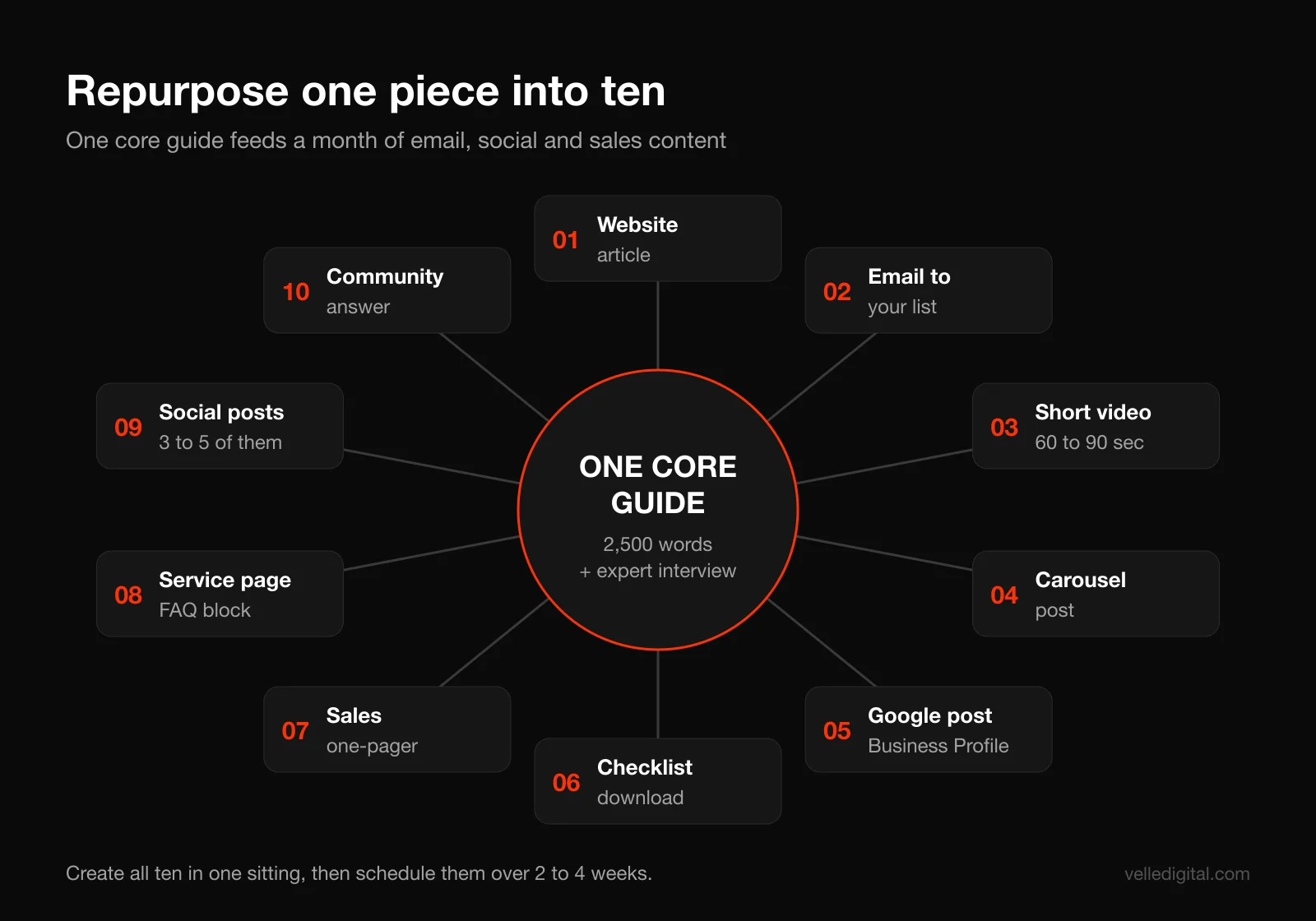
How to do it efficiently: record an expert interview first if you can, because it is the richest raw material; create all derivatives in one two-hour sitting the day after publishing; adapt each one to its platform rather than pasting the same text everywhere (a carousel needs a strong first slide, a short video needs its hook in the first two seconds); and schedule them across two to four weeks.
If short video is one of your derivative formats, our guide to short-form video for business covers filming and editing with a phone and a small budget.
Step 9: Distribute it on purpose
"If you build it, they will come" does not apply to content. A new page on a small site might take months to rank, and many of your best pieces will never rank at all. Distribution is not optional. A good rule of thumb is to spend as much time getting a piece in front of people as you spent making it, especially in the first year.
Plan distribution across four channels:
Your email list is the only channel you fully own. Every core piece should go to it.
- Send one idea and one link, with a subject line about the reader's question, not your news. "What a kitchen remodel really costs in 2 minutes" beats "Our October newsletter."
- Add your best evergreen articles to your welcome sequence.
- If you email Canadians, make sure your list complies with Canada's Anti-Spam Legislation (CASL), which covers consent for commercial electronic messages.
Our guide to email marketing for small business covers list building, welcome sequences and newsletters in detail.
Social media
Post the Step 8 derivatives on the one or two platforms where your buyers spend time: usually Facebook and Instagram for local services, LinkedIn for B2B. Lead with the insight itself rather than a bare link.
When you share links, add UTM tags with Google's Campaign URL Builder so your analytics shows which posts sent traffic and leads. For a full planning system, see our social media marketing plan.
Communities
Local Facebook groups, neighborhood apps, subreddits and industry forums are where buyers ask questions in public. Answer fully in the thread and link to your guide only when it adds detail a reply cannot hold. Follow each community's self-promotion rules, and never drop the same link in ten groups in one day.
Partnerships
Partners already have the audience you want. Look for businesses that serve your customers before or after you: for a renovation company, realtors, mortgage brokers and designers; for a bookkeeper, business lawyers and payroll providers.
Offer something useful: a guest article for their newsletter, a co-hosted workshop, or a jointly written guide ("Buying a fixer-upper: what your realtor and your contractor want you to know"). These relationships also produce the most natural, relevant backlinks you will get.
Distribution checklist for every core piece:
- Sent to email list (or scheduled in next newsletter)
- Derivative social posts scheduled across two to four weeks
- Google Business Profile post published
- Shared with the sales team, with a note on when to send it
- Added to relevant service pages and older articles as an internal link
- Shared with one partner or community where it genuinely helps
Step 10: Measure content ROI, not just traffic
You measure a content marketing strategy the same way you measure any investment: what did it cost, and what did it return? Traffic is a leading indicator, not the result.
Track three layers of metrics:
Layer 1: visibility (monthly)
- Search Console impressions, clicks and average position for content pages (the report defaults to the past three months; compare periods).
- Organic sessions to content pages in GA4.
Layer 2: engagement (monthly)
- Engagement time, email signups, downloads and clicks to service pages.
Layer 3: business results (monthly and quarterly)
- Leads (form submissions, calls, bookings) where a content page was part of the journey.
- Qualified leads and closed revenue from those leads.
- Sales cycle length and close rate for leads who read content versus those who did not.
To get Layer 3 working:
- Mark lead actions as key events in GA4 (form submissions, click-to-call, bookings). Google explains how to mark events as key events.
- Use the landing page report to see which pages started sessions that ended in a key event.
- Add "How did you hear about us?" to forms and first calls. It catches the prospect who read three articles on their phone and called from a desk phone a week later.
- Record the source in your CRM so you can follow each lead to closed revenue.
- Ask sales which articles they send and which ones prospects mention.
Here is a worked example with hypothetical numbers, so you can see the math:
- Costs over 12 months: 24 core articles. Writing outsourced at 600 dollars each (14,400 dollars), plus 2 hours of expert time per article valued at 100 dollars an hour (4,800 dollars), plus 3,000 dollars for figures and photography. Total: 22,200 dollars.
- Results by month 12: content pages bring 1,500 organic sessions a month, and 1.2% of those sessions end in a quote request. That is 18 quote requests a month.
- Over the full year, as traffic ramps up, say the content produces 110 quote requests in total. The team closes 20% of them: 22 projects.
- At an average project value of 30,000 dollars and a 25% gross margin, each project is worth 7,500 dollars in gross profit. 22 projects produce 165,000 dollars of gross profit.
- Content ROI in year one: (165,000 minus 22,200) divided by 22,200, or roughly 6.4 times the investment.
Your numbers will differ, and year one is usually the weakest. The point is the method: tie content to leads and revenue, value expert time honestly, and judge the program over 12 months rather than 12 weeks.
Decision rules for reading your data:
- If a page has high impressions but a low click-through rate, rewrite the title and meta description to match the searcher's question more closely.
- If a page gets traffic but no clicks to service pages or leads, improve the call to action and internal links, or check whether the page attracts the wrong audience.
- If a page ranks on page two for a valuable keyword, it is your best refresh candidate (see Step 11).
- If a whole cluster gets no traction after six months, check whether the search results favor a different format (service pages, local listings, videos) before writing more.
If measurement is where you get stuck, a marketing audit will show what your analytics is and is not tracking before you invest more in content.
Step 11: Refresh and prune old content
Your existing content is often the fastest win. A page that already ranks on page two needs a refresh, not a replacement, and refreshing takes a fraction of the time of writing something new.
Run a content review every quarter:
- Export your content pages with their clicks, impressions and average position from Search Console (last 12 months), and their sessions and key events from GA4.
- Sort every page into one of four buckets (listed below).
- Refresh the most valuable pages first. Use the business value score from Step 3.
The four buckets:
- Keep: performing well and still accurate. Leave it alone, check it again next quarter.
- Refresh: ranking positions 5 to 20, or traffic declining year over year, or information that is out of date.
- Merge: two or more pages covering the same question and competing with each other.
- Remove: no traffic, no leads, no links, and no value to a reader. Thin announcements and outdated promotions usually land here.
What a real refresh includes: updated facts, prices and screenshots; new sections for queries the page appears for in Search Console but does not answer; fresh first-hand examples or figures; a faster introduction; internal links to and from newer articles; and cuts to sections that no longer earn their place.
Be careful with dates. Google's helpful content guidance specifically warns against "changing the date of pages to make them seem fresh when the content has not substantially changed." Only update the visible date when you have made substantial changes. Google's documentation on publication dates explains how to show dates clearly and mark them up with datePublished and dateModified.
When you merge or remove pages, do not just delete them. Use a permanent (301) redirect from the old URL to the most relevant remaining page, as described in Google's guide to redirects and Google Search. This keeps visitors and any links the old page earned. Then request recrawling of the updated page through the URL Inspection tool in Search Console.
Decision rule: if more than a third of your content would land in Merge or Remove, stop publishing new content for a month and fix the library first. A smaller set of strong pages beats a large set of weak ones.
Step 12: Run the 90 day plan
Here is the plan we would run for a small business starting from little or no content, publishing two core pieces a month.
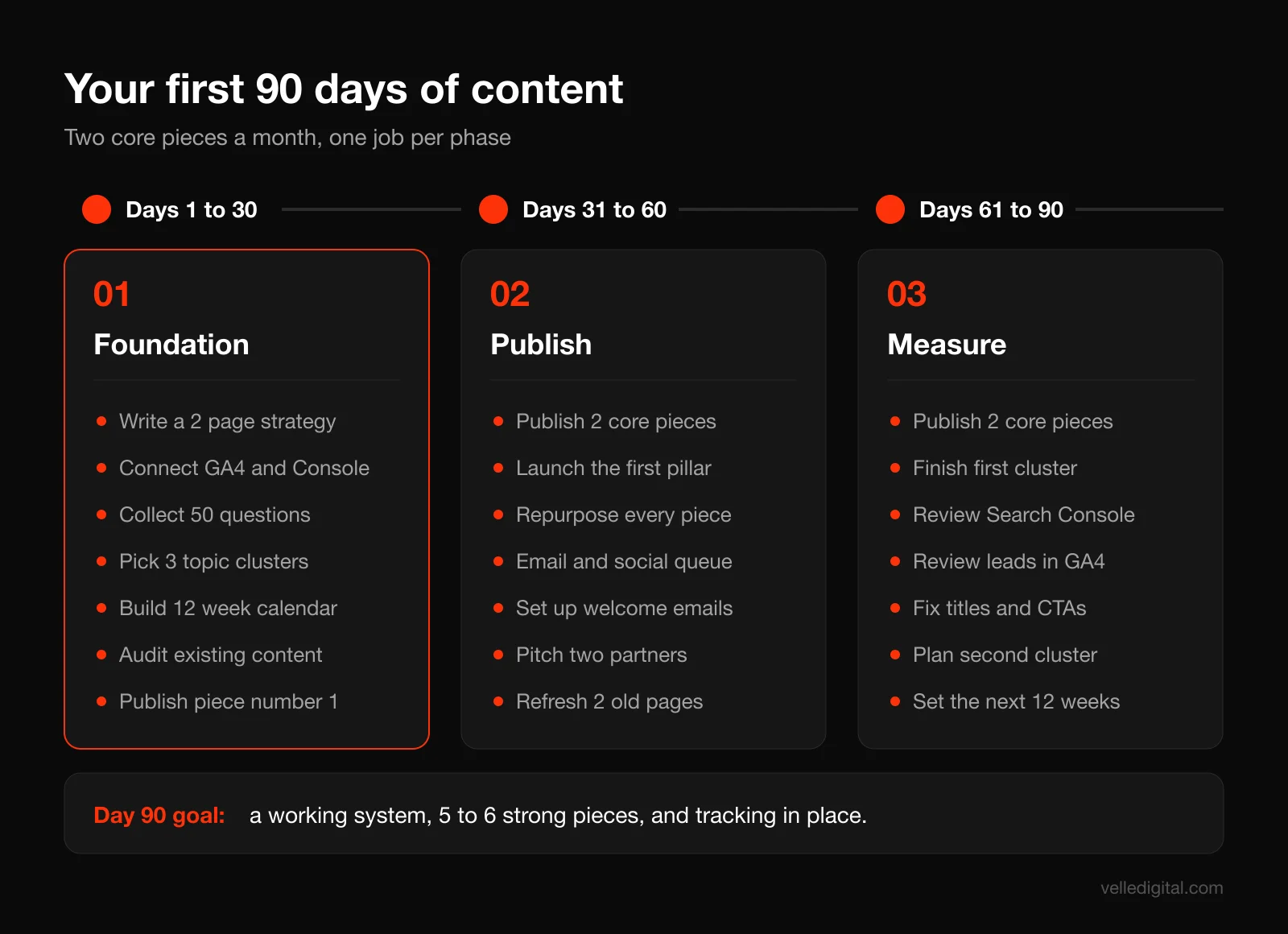
Days 1 to 30: foundation
- Write your two-page strategy: goals, buyers, clusters, core format, pace, distribution channels, metrics.
- Connect Google Search Console and GA4, and mark lead actions as key events.
- Add a "How did you hear about us?" field to your forms and CRM.
- Collect at least 50 real buyer questions using the sources in Step 2.
- Group them into three clusters, score the ideas, and build a 12 week calendar.
- Audit any existing content into Keep, Refresh, Merge and Remove.
- Record two expert interviews (30 to 45 minutes each) for your first two articles.
- Publish your first core piece by day 30, ideally the most commercially valuable question in your first cluster (often a cost or pricing guide).
Days 31 to 60: publish and distribute
- Publish two more core pieces, including the first cluster's pillar page, and keep two drafts ahead.
- Repurpose each core piece into its derivatives in one sitting the day after publishing.
- Send each piece to your email list and schedule derivatives on social across two to four weeks.
- Set up your welcome email sequence with your best two articles.
- Share each piece with your sales team, with a note on when to send it.
- Approach two partners about a guest article or co-created resource.
- Refresh the two highest value pages from your existing content audit.
Days 61 to 90: measure and adjust
- Publish two more core pieces, completing the core of your first cluster.
- Review Search Console: which pages are getting impressions, and for which queries? Add answers to the queries you missed.
- Review GA4: which pages are driving clicks to service pages and key events?
- Adjust the calendar for the next quarter: double down on what is working, drop topics that clearly attract the wrong audience.
- Plan your second cluster and the next 12 weeks.
What to expect at day 90: honestly, modest search traffic. New pages on small sites often take several months to settle into their rankings. What you should see by day 90 is a working system: a calendar that is on schedule, a library of five to six strong pieces, email and social filled with useful content, sales using your articles in conversations, and measurement that will show you real results by month six to twelve.
Content marketing strategy mistakes to avoid
These are the patterns we see most often when we review a business's content, roughly in order of cost.
- No link between content and sales. Fix: put your sales lead or owner in the monthly content review.
- Writing for search engines instead of buyers. Fix: start every piece with a real buyer question.
- Targeting keywords you cannot win. Fix: add local, specific or practical angles.
- Too many clusters at once. Fix: finish one cluster before starting the next.
- Inconsistent publishing. Fix: set the pace for your busiest month and work two pieces ahead.
- Generic, interchangeable content. Fix: an expert interview for every core piece.
- The wrong call to action. "Book now" on an early research article, or nothing on a pricing guide. Fix: match it to the stage.
- Publishing without distributing. Fix: the Step 9 checklist, every time.
- Measuring traffic instead of leads. Fix: key events, self-reported attribution and CRM source tracking.
- Gating everything. Fix: gate only genuinely useful extras like templates, never basic answers.
- Giving up at month three. Content compounds. Fix: commit to a 12 month evaluation window before you start.
Content marketing strategy checklist
Use this as a one-page review before each quarter.
Strategy
- One or two business goals written down, tied to pipeline stages
- One or two buyer profiles, with the words they use
- At least 50 real buyer questions sorted by stage
- Three topic clusters tied to your highest value services
- One core format at a pace you can keep in your busiest month
Production
- Editorial calendar filled for 12 weeks, two drafts ahead
- Expert input and a real byline on every core piece
- Direct answer in the first two paragraphs, scannable headings and lists
- Original photos, figures or examples
- FAQ, a stage-matched call to action, and links to the pillar and service page
Distribution
- Repurposed into derivatives in one sitting
- Sent to the email list and scheduled on one or two social platforms with UTM tags
- Shared with sales and at least one partner or community
Measurement and maintenance
- Search Console and GA4 connected, lead actions marked as key events
- "How did you hear about us?" on forms and in the CRM
- Monthly review of visibility, engagement and leads by page
- Quarterly content review: Keep, Refresh, Merge, Remove
- One refresh slot every month
- 301 redirects for any merged or removed page
Frequently asked questions
What is a content marketing strategy?
A content marketing strategy is a documented plan for creating and distributing content that attracts, informs and converts a specific audience into customers. It defines your goals, your target buyers, the topics and questions you will cover, the formats and publishing pace, how each piece will be distributed, and how you will measure results.
How do I create a content marketing strategy for a small business?
Start by tying content to one or two business goals, then collect at least 50 real questions from your customers, sales conversations and Google Search Console. Group the questions into three topic clusters, choose one core format you can sustain, and build a 12 week editorial calendar. Repurpose and distribute every piece deliberately, measure leads rather than traffic, and refresh your best pages every quarter.
How often should a small business publish content?
Publish at the pace you can sustain during your busiest month, which for most small businesses is one or two strong pieces a month. Consistency and quality matter far more than volume, and Google has said it has no preferred word count or publishing frequency. Two specific, well-distributed articles a month for a full year will outperform a burst of daily posts that stops after six weeks.
How long does content marketing take to work?
Expect a working system in the first 90 days and measurable search traffic and leads somewhere between six and twelve months, depending on your competition and how much content you publish. Content that you distribute through email, social and your sales team can produce results immediately, while search traffic builds more slowly as pages are indexed and earn trust. Judge the program over 12 months, not 12 weeks.
How do you measure content marketing ROI?
Add up the full cost of your content (writing, expert time, design and tools), then track the leads and revenue it produced using GA4 key events, a "How did you hear about us?" field on your forms, and source tracking in your CRM. Divide the gross profit from content-sourced customers, minus the cost, by the cost. Traffic, rankings and engagement are useful leading indicators, but ROI comes from closed business.
Can I use AI to write my content?
You can use AI to transcribe interviews, outline, edit and repurpose, and Google has said appropriate use of AI is not against its guidelines. What AI cannot provide is your experience: the specific examples, numbers, mistakes and judgment that make content trustworthy and different from everyone else's. Mass-producing AI pages mainly to rank can fall under Google's scaled content abuse policy, so keep a human expert at the center of every piece.
What is the difference between content marketing and SEO?
SEO is the work of helping search engines find, understand and rank your pages, including technical setup, site structure and keyword targeting. Content marketing is the broader practice of creating useful content and distributing it through search, email, social, partnerships and sales. They overlap heavily: SEO without good content has nothing to rank, and content without SEO is much harder for buyers to find.
Ready to put your content marketing strategy to work?
A content marketing strategy pays off when it is specific to your buyers, built at a pace you can keep, and measured in leads rather than likes. If you would rather spend your time running the business while someone else turns your team's expertise into content that ranks and sells, our content marketing team can build and run the plan with you, working alongside our SEO services so every piece is found by the people ready to buy. Book a free strategy call and we will look at where your content stands today and what the first 90 days should look like.